The Bolshevik Seizure of Power, October 1917 (AQA A Level History: Component 1: Breadth study): Revision Note
Exam code: 7042

Summary
The Bolsheviks seized power in Petrograd on 24-25 October 1917, overthrowing the Provisional Government in a planned operation
Trotsky directed the takeover through the Military Revolutionary Committee
Lenin pushed for action before the Congress of Soviets met
The Second All-Russian Congress of Soviets approved a new Bolshevik government
It was called the Sovnarkom; Lenin chaired it, and it was made up entirely of Bolsheviks
Lenin's first decrees helped win mass support
The Decree on Peace promised an end to the war
The Decree on Land promised land redistribution to the peasants
By December 1917, Bolshevik control was real but incomplete
They held the major cities and railways
But they still faced strikes, rival parties and a hostile countryside
The Cheka was created to enforce control
Historians debate how secure Lenin's power was by December 1917
A genuine takeover that held the new government and the major cities
Harding argues that a modest and far-from-complete grip on a vast and divided country
Key members of the Bolshevik Party: Lenin, Trotsky and others
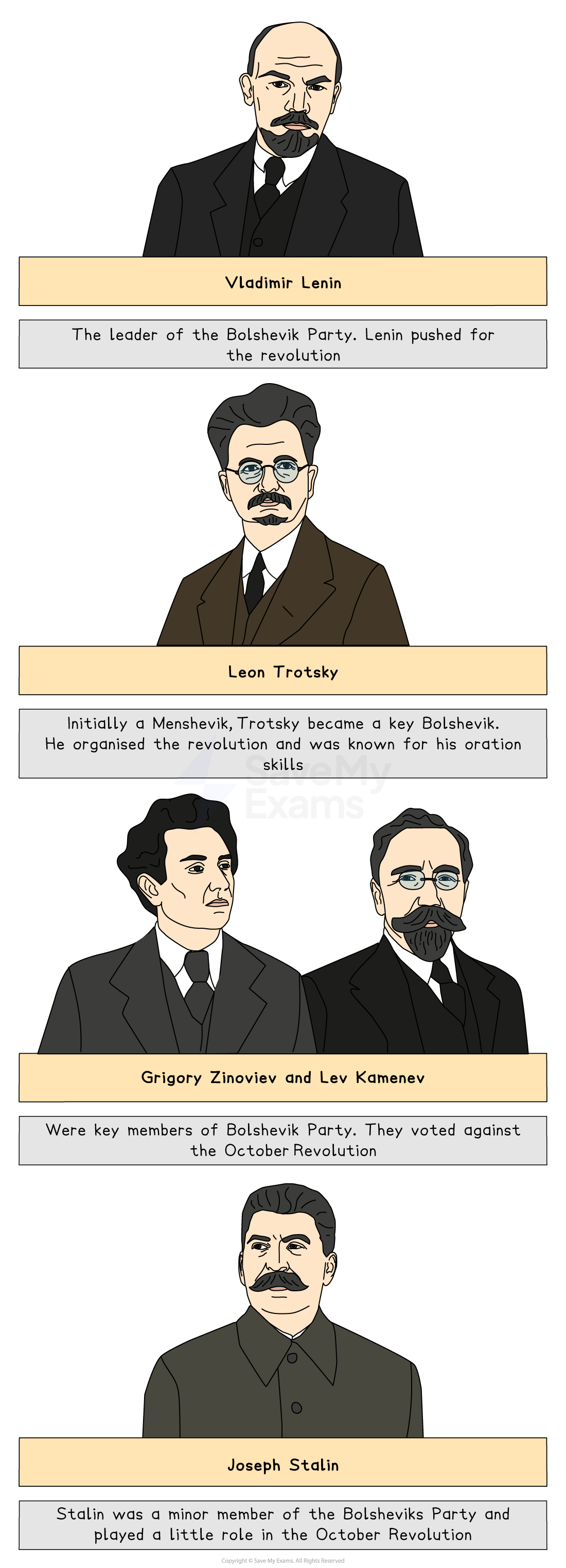
The October seizure of power was the work of a small, disciplined leadership, not a mass uprising
Lenin had built the Bolsheviks into a vanguard party of professional revolutionaries
Party membership grew from around 23,000 in February 1917 to around 200,000 by October
Lenin pushed the party towards an armed seizure of power
He returned from exile in April 1917 and argued that the moment had come
He sent letters to the Central Committee demanding that they seize power before the Congress of Soviets met
Trotsky was the chief organiser of the coup
He became chairman of the Petrograd Soviet in September 1917
He was also a powerful public speaker
Zinoviev and Kamenev opposed the seizure of power
They wanted to wait for the Constituent Assembly elections and create a coalition government through legal means
Stalin played only a minor role in the events of October 1917
Examiner Tips and Tricks
October was not “Lenin’s revolution” alone. Trotsky organised the seizure through the Military Revolutionary Committee, while Kamenev and Zinoviev opposed the timing, so the strongest answer weighs how far the takeover really depended on Lenin as an individual.
Knowing each figure’s stance is what lets you judge the role of individuals, which is exactly what those questions test.
Events of the Bolshevik seizure of power, October 1917
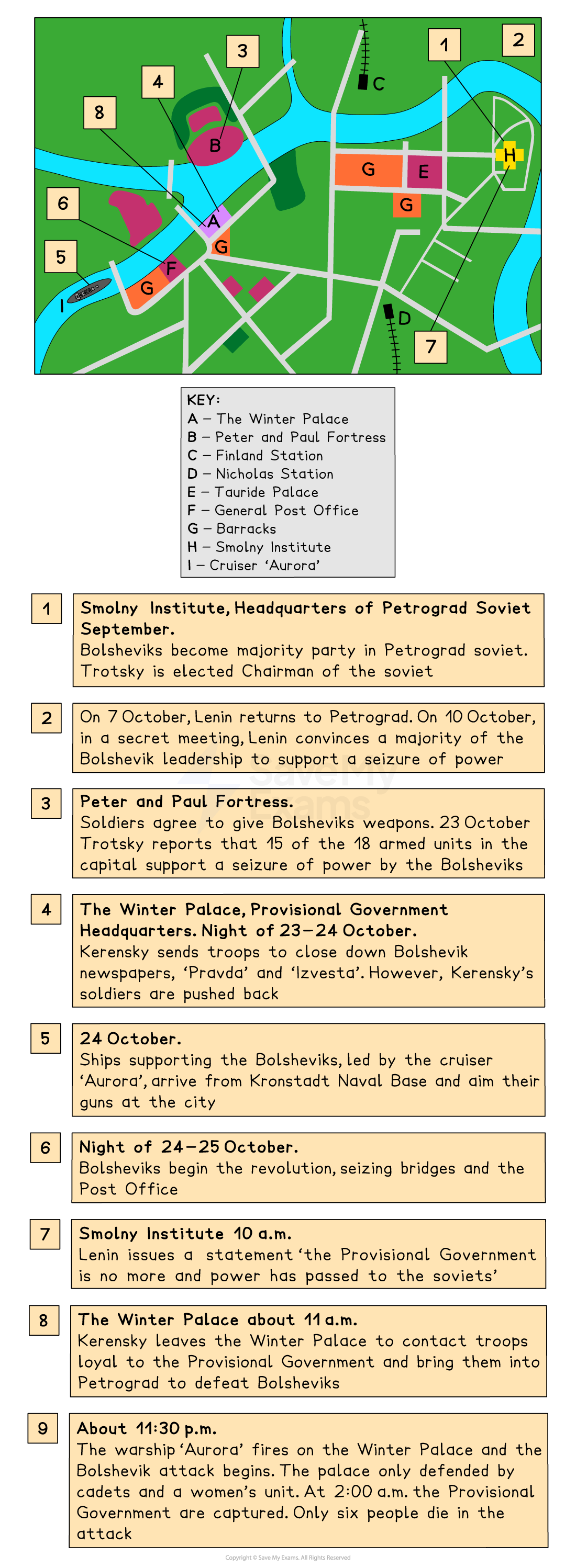
The Military Revolutionary Committee
The Petrograd Soviet set up the Military Revolutionary Committee (MRC) in October 1917
It was led by Trotsky and gave the seizure the cover of authority
The Bolsheviks could claim they were defending the Soviet, not staging a coup
It also gave Trotsky command over the armed Red Guards
The Kornilov Affair in August had strengthened the Bolsheviks
Workers and soldiers trusted them after they helped block Kornilov's advance on Petrograd
The seizure of power, 24-25 October
On the night of 24-25 October, the Red Guards and pro-Bolshevik soldiers took the key areas of Petrograd
They seized bridges, railway stations, the telegraph and the State Bank
There was little resistance, as most units remained neutral or backed the soviet
The Provisional Government was left isolated in the Winter Palace
Its guard was a mix of cadets, Cossacks and members of the Women's Battalion
The armed party that broke into the palace was led by Bolshevik Antonov-Ovseenko
The warship Aurora fired a single blank signal shot at the Winter Palace at 9:40 pm on 25 October
The palace was taken in the early hours of 26 October, and the ministers were arrested
“At around 10pm, a shot was fired in the palace, followed by cries and shots from the cadets. About 50 hostile sailors and soldiers were arrested and disarmed ... At about 2:00 am, there was a loud noise at the entrance to the palace. The armed mob of soldiers, sailors and civilians, led by Antonov, broke in. They shouted threats and made jokes. Antonov arrested everyone in the name of the Revolutionary Committee.”
S. Maslov, Minister of Agriculture in the Provisional Government, recalling events inside the Winter Palace on 25 October
Myth vs reality
The "storming" of the Winter Palace was far smaller than later propaganda suggested
Trotsky himself estimated that at most 25,000 to 30,000 people were actively involved
Around 5% of the city's workers and soldiers
Only 6 people were reported to have been killed in the attack
Leading to the nickname, the 'Bloodless Revolution'
Every day life in Petrograd carried on through the seizure
Trams and taxis ran as normal
Restaurants, theatres and cinemas stayed open
Eisenstein's 1927 film October later invented the dramatic mass assault that people associate with the revolution
This mattered, as the Bolsheviks needed the takeover to look like a popular rising, not a coup
Examiner Tips and Tricks
Watch the dating trap. These events use the Old Style (Julian) calendar, 13 days behind the West, so the seizure of 25 October is 7 November on our calendar.
State which calendar you are using once, then stay consistent. Mixing the two without explanation costs marks for precision.
The Sovnarkom, the Congress of Soviets and Lenin’s first decrees
The Second All-Russian Congress of Soviets
The Congress met at the Smolny Institute as the seizure was being completed
Around 670 delegates attended its opening sessions
The Bolsheviks and left Socialist Revolutionaries together held the majority
Lenin claimed that the Bolsheviks had seized power on behalf of the soviets
This gave the revolution a democratic appearance
The Mensheviks and right-wing Socialist Revolutionaries walked out in protest
Their exit left the Bolsheviks and left-wing Socialist Revolutionaries in control of Congress
Around 500 delegates voted to approve a new socialist government
The Menshevik leader Tsereteli predicted that Bolshevik rule would last no more than three weeks
"Get out of here to where you belong, in the dustbin of history."
Trotsky speaking after the Mensheviks and SRs walked out of the Second All-Russian Congress of Soviets
The Sovnarkom
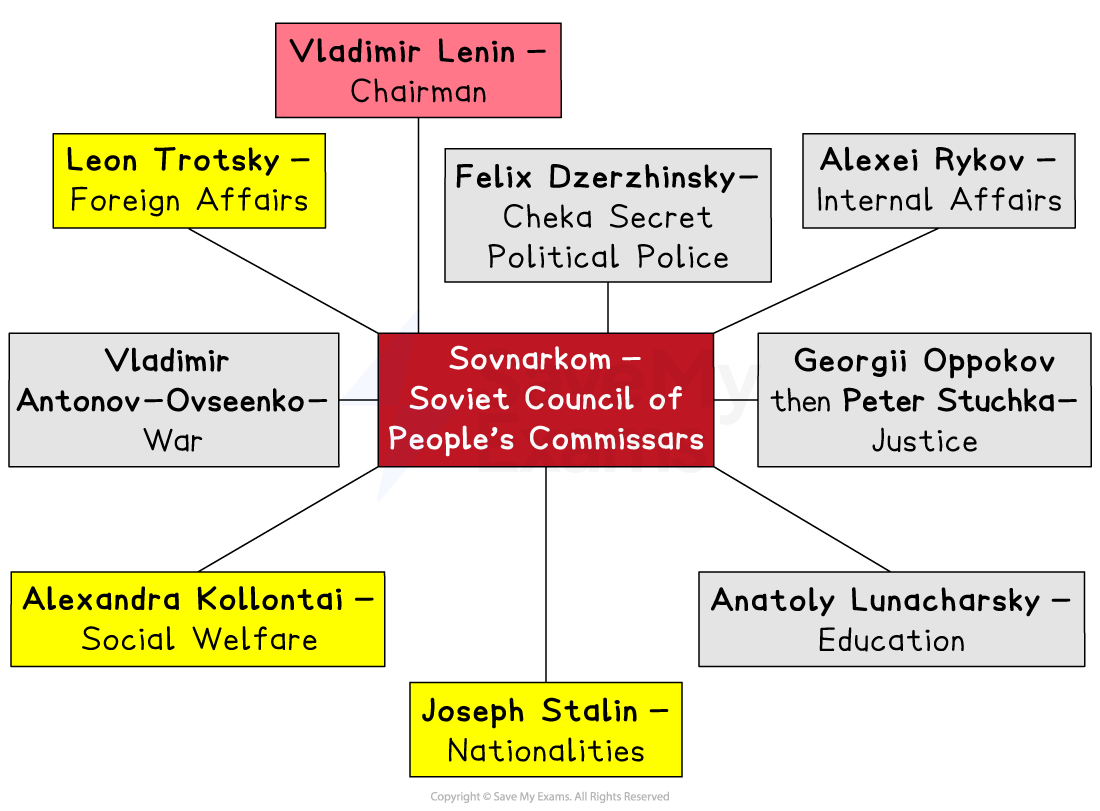
The Congress established the Sovnarkom, the Council of People's Commissars, as the new government
13 People's Commissars made up the first Sovnarkom
Lenin was Chairman
Trotsky was Commissar for Foreign Affairs
Stalin was Commissar for Nationalities
Every member was a Bolshevik
Alexandra Kollontai was the only woman
The title 'commissar' was chosen to mark a break from the old bourgeois ministers
The Sovnarkom gave the Bolsheviks direct control of policy and law-making
The Sovnarkom was supposed to answer to the Congress of Soviets
In reality, Lenin bypassed the Congress and ruled through Sovnarkom decrees
Lenin's first decrees
Lenin issued several decrees in his first few months in power
The Congress of Soviets approved the decrees
The Decree on Peace (26 October) called for an immediate end to the war
It suggested peace with no annexations or indemnities
It led to an armistice on the Eastern Front before the end of 1917
The Decree on Land (26 October) abolished private ownership of land
It legalised the peasants' seizure of estates without compensation to landlords
This was originally an SR idea; therefore, Lenin undercut his rivals, buying time to consolidate
Further decrees through November and December extended Bolshevik control
November:
Workers' control of factories
Self-determination for national minorities
Elected people's courts
End of legal discrimination against women
December:
The army lost its ranks and saluting
The Church lost control of land and marriage
Banks were nationalised
Positive impacts of the decrees
The decrees were popular with workers, peasants, and soldiers
They seemed to deliver the Bolsheviks’ promises quickly
Ending Russia's involvement in the First World War allowed Lenin to:
Rebuild the economy
Establish a new government
Negative impacts of the decrees
The Bolsheviks only held power in Petrograd
The majority of Russia's territory had not heard about the revolution or was not under Lenin's control
The Bolsheviks had little ability to enforce them across Russia in late 1917
Examiner Tips and Tricks
The Decree on Land was really the Socialist Revolutionary programme, not an original Bolshevik one. The strongest answers see that Lenin won support by adopting popular demands, not by imposing socialism.
Link the decrees directly to survival: peace and land are why the regime held on through its first weeks.
Opposition to the Bolshevik seizure of power
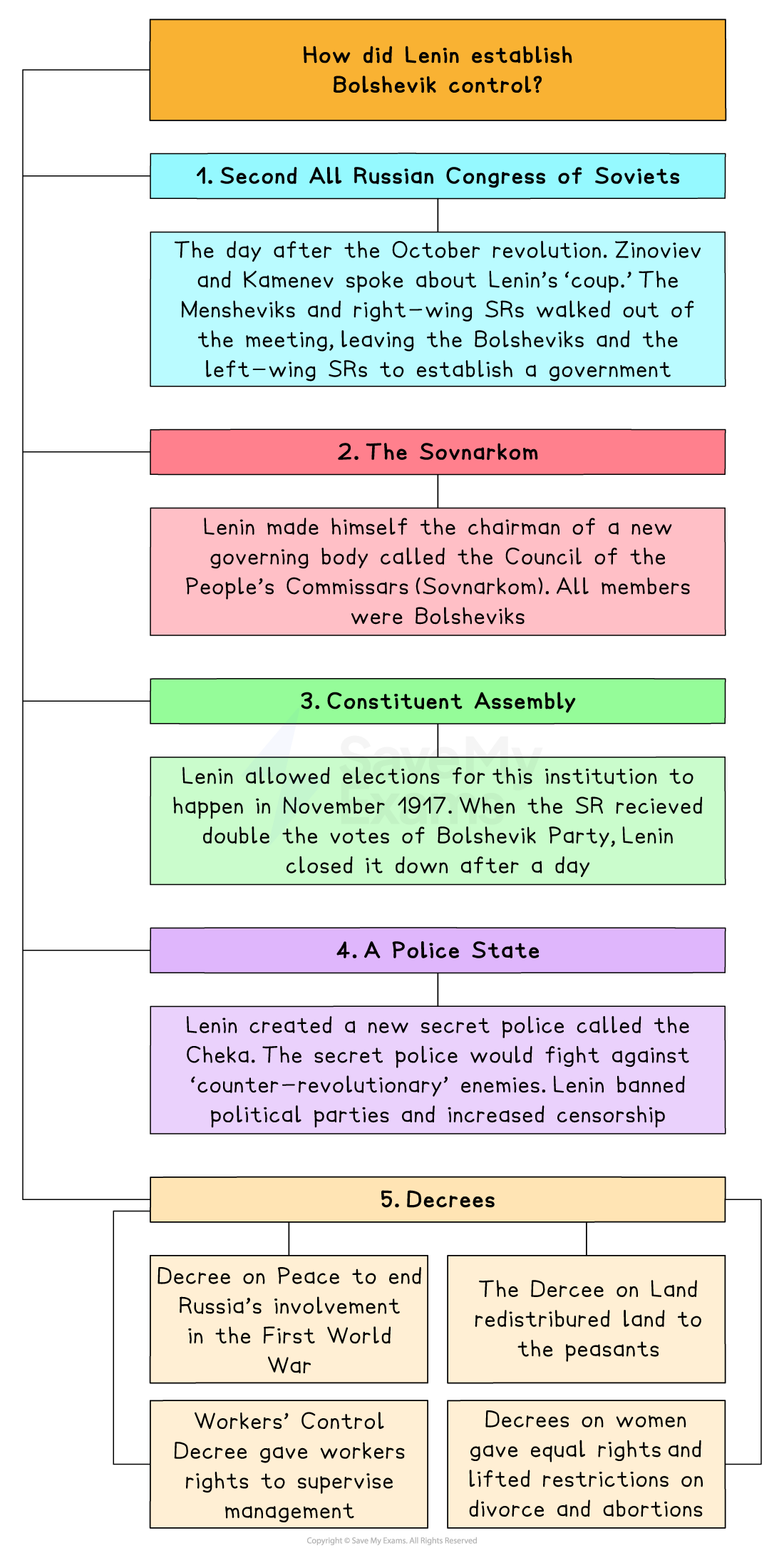
The new regime was not secure
Taking power proved easier than keeping it, and Bolshevik control was thin at first
Civil servants refused to work for the new government
Bankers refused finance; it took ten days and the threat of armed force to make the State Bank release its reserves
Armed opposition threatened Petrograd within days
Kerensky gathered loyal troops and advanced on the capital with forces that outnumbered the Bolsheviks
There was fierce fighting in Moscow between government supporters and Bolshevik forces
Workers' organisations challenged one-party rule
The railway union, Vikzhel, threatened to strike unless the Bolsheviks formed a broad socialist coalition
The threat forced brief talks, but Lenin refused to share real power
How the Bolsheviks fought back
Lenin combined concession with force to break the opposition
Concessions kept the workers and peasants onside
The decrees on peace and land delivered what most ordinary people wanted
Force silenced political rivals
The Cheka, a new secret police, was created in December 1917 to crush counter-revolution
The Red Guard patrolled the streets
The Bolsheviks closed hostile newspapers, purged the civil service and arrested leading Kadets and other opponents
Examiner Tips and Tricks
Avoid simply saying the opposition “failed”. The stronger argument is that the Bolsheviks neutralised it by mixing force (the Cheka and Red Guards) with concession (peace and land), while their rivals stayed divided.
The Vikzhel strike threat and Kerensky’s advance show the regime was genuinely threatened, not yet secure.
How complete was Lenin’s power by December 1917?
By December 1917, the Bolsheviks ran a government and held cities
But how far this amounted to real control over Russia is a matter of debate
Lenin's power was real and rapidly consolidated
The Bolsheviks built a working government within weeks
The Sovnarkom was issuing decrees and exercising authority from late October
The party held Petrograd, Moscow and the railway network by the end of the year
They defeated the first attempts to remove them
Kerensky's advance on Petrograd collapsed and his troops drifted away
The Cheka gave the regime a tool to suppress opposition quickly
Popular decrees gave the regime a base of support
Peace and land answered the immediate demands of the people
Lenin's power was limited and far from complete
The Bolsheviks controlled only a fraction of the country
Their authority was real in the cities but weak across the countryside
Large rural areas stayed outside Bolshevik control altogether
The seizure itself had rested on a small, active minority
Trotsky's own figures suggest only around 5% of the city took part
The people had not voted for Bolshevik rule
In the November elections to the Constituent Assembly, the Bolsheviks won just under a quarter of the vote
Other socialist parties, not the Bolsheviks, held the majority of seats
Open conflict was already building
Strikes, rival parties and armed resistance pointed towards civil war
Key historian
"The promise of the Russian Revolution, as conceived by Lenin, was more modest by far. It was no more than to fulfil the democratic revolution in the most radical way conceivable and thereby to ensure, in the future, the most favourable circumstances for the transition to socialism step by step.”
N. Harding, Lenin, Socialism and the State in 1917 (1992)
Harding argues that Lenin’s aims in 1917 were deliberately limited
This supports the view that the Bolsheviks had a modest, practical foothold rather than total control by December.
Examiner Tips and Tricks
The best answers weigh real control (the Sovnarkom formed, key cities and railways held, decrees issued) against clear limits (just under a quarter of the Constituent Assembly vote, the countryside outside Bolshevik reach, civil war looming)

Unlock more, it's free!
Join the 100,000+ Students that ❤️ Save My Exams
the (exam) results speak for themselves:

Was this revision note helpful?
