Lenin’s Government: Building the One-Party State, 1917–1924 (AQA A Level History: Component 1: Breadth study): Revision Note
Exam code: 7042

Summary
Lenin built a one-party state after October 1917, shutting out rival parties
The Constituent Assembly was elected in November 1917, but Lenin closed it after a single day in January 1918
Power shifted from the soviets to the Communist Party
The Politburo, created in 1919, became the real centre of decision-making
The Cheka, founded in December 1917, drove the Red Terror of 1918 to 1921 against real and suspected enemies
The 1921 ban on factions ended open debate inside the Party
The 1924 Constitution then formalised the USSR under Party control
Historians debate whether Lenin’s “dictatorship of the proletariat” was a step towards communism or a way to concentrate power in the Party
Nettl argues that Lenin justified Bolshevik rule through revolutionary action, not elections or popular consent
The Constituent Assembly, 1918: why did Lenin shut it down?
Party | Votes (in millions) | Number of Seats | % of Vote |
|---|---|---|---|
Socialist revolutionaries (SRs) | 21.8 | 410 (including 40 left-wing) | 53 |
Bolsheviks | 10.0 | 175 | 24 |
Kadets | 2.1 | 17 | 5 |
Mensheviks | 1.4 | 18 | 3 |
Others | 6.3 | 62 | 15 |
Table – The Constituent Assembly election results, November 1917
Why the elections went ahead
The Bolsheviks inherited a promise to hold elections to a Constituent Assembly
The Provisional Government had already promised to hold them
Cancelling the vote would have looked like an open seizure of power
Lenin allowed the elections to take place in November 1917
The Bolsheviks had only just taken power in October
They wanted to appear legitimate
Their slogan, "All power to the Soviets", suggested popular government
Why the result was a problem for Lenin
The Bolsheviks won less than a quarter of the vote
The Socialist Revolutionaries (SRs) won the most seats
An elected assembly could claim more authority than the Sovnarkom
A free assembly threatened Bolshevik control
It could have voted the Bolsheviks out
It challenged Lenin’s belief in rule by a disciplined revolutionary party
In State and Revolution, Lenin had argued that the proletariat needed a strong party to guide the people, not a parliament
How and why Lenin shut it down
The Assembly met for a single day in January 1918
Red Guards then closed it and refused to let it meet again
Troops fired on demonstrators in support of the Assembly
Twelve demonstrators were killed
Lenin justified the closure through ideology, not democracy
He described elected assemblies as a lower, 'bourgeois' form of rule
He claimed the soviets were a higher form of democracy
The left SRs briefly stayed in coalition with the Bolsheviks, giving Lenin a thin claim to represent “the people”
Closing the Constituent Assembly marked the start of one-party rule
The Bolsheviks had shown that they would not share power
Party control now mattered more than electoral consent
“The dissolution of the Constituent Assembly means the complete and open repudiation of democracy in favour of dictatorship. This will be a valuable lesson.”
Lenin speaking in 1918
Examiner Tips and Tricks
Do not confuse the Sovnarkom with the Constituent Assembly. The Sovnarkom was Lenin’s Bolshevik government. The Constituent Assembly was an elected body chosen by voters to decide Russia’s future political system.
Political centralisation under Lenin: power to the party
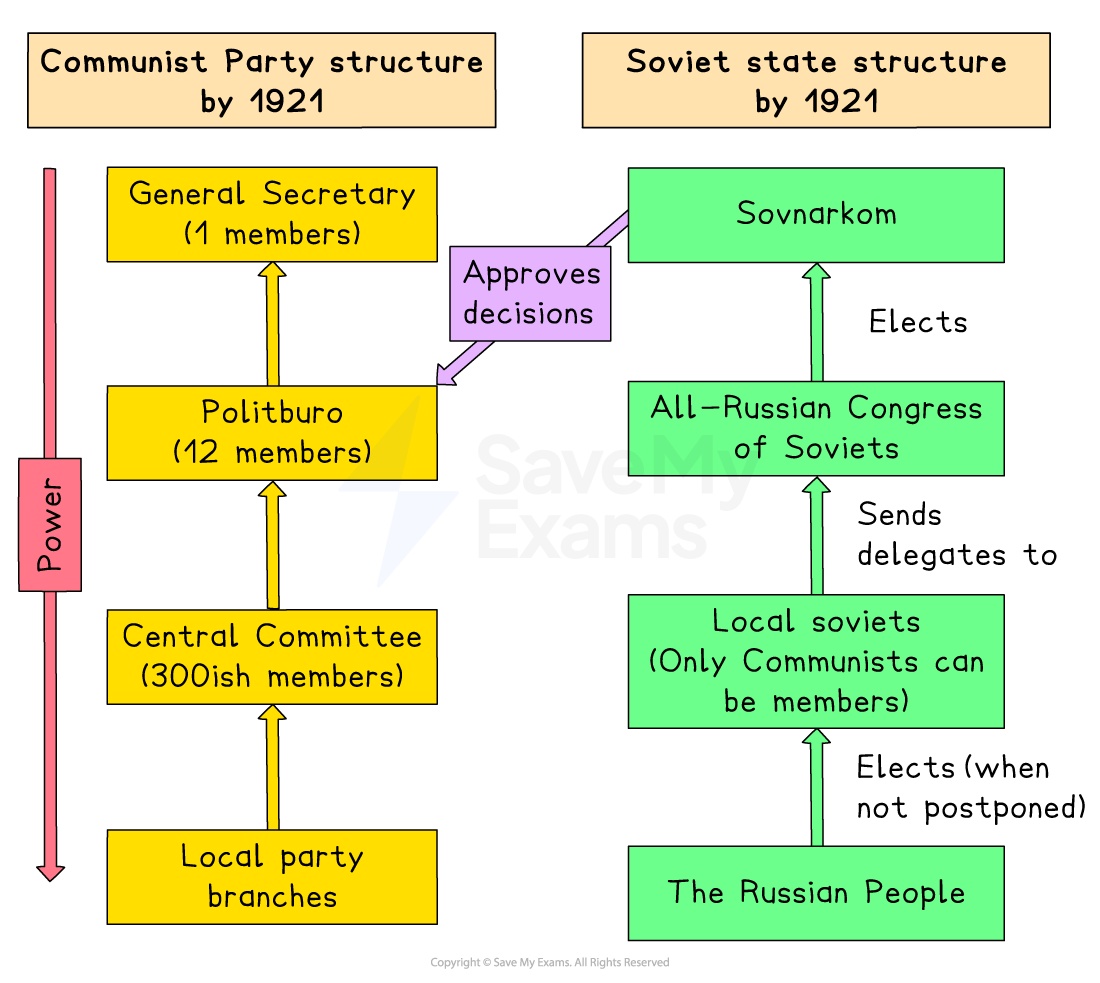
From the soviets to Sovnarkom
Lenin had promised "All power to the Soviets" in his April Theses
In practice, he ruled through the Sovnarkom, a Bolshevik-only cabinet of commissars
The Sovnarkom became the centre of government
It met once or twice a day
It is governed by decree
It made key decisions without wider approval
The wider Soviet was sidelined
It met less often
It had less influence over policy
Lenin made peace talks and key decrees without its approval
'Squeezing out' the other parties
Lenin refused to share power with other socialist parties
He sidelined the Mensheviks and most SRs
Despite a shared Marxist belief
Some Bolsheviks who wanted a broad coalition resigned in protest
The left-wing SRs left the Sovnarkom in 1918
They opposed the signing of the Treaty of Brest-Litovsk
From that point, the Bolsheviks governed alone
In March 1918, they renamed themselves the Communist Party
The Party above the state
Real power moved from state bodies to Party bodies
The Politburo, set up in 1919, became the true centre of power
The Central Committee directed Party affairs and elected the Politburo
Decisions flowed down through the Party, then to the state
Democratic centralism justified control from the top
Debate was allowed before a decision
Once a decision had been made, all Party members had to obey
This gave the leadership a free hand once it had been decided
Examiner Tips and Tricks
The strongest answers trace power moving away from the soviets towards the Party. Use the slogan “All power to the Soviets” to show the gap between Bolshevik promises and Bolshevik practice.
The use of terror under Lenin: the Cheka & the Red Terror
Why did the Bolsheviks use terror?
Lenin argued that violence was needed to protect the revolution
The Bolsheviks faced armed opposition during the Civil War
Terror was presented as a weapon against counter-revolution
Terror increased when the Bolsheviks felt threatened
Alexander Antonov led a major peasant rebellion in 1921
Sailors at the Kronstadt naval base rebelled in 1921
The creation of the Cheka
Lenin set up the Cheka in December 1917
It was a secret police force
It was led by Felix Dzerzhinsky, known as 'Iron Felix'
Its job was to crush counter-revolutionary activity
The Cheka became a key tool of Bolshevik control
It was based in the Lubianka building in Moscow
The regime quickly used it against rival parties
The Sovnarkom banned the opposition press in October 1917
Rival leaders were arrested
Kadet, Menshevik and SR leaders were targeted
The Red Terror, 1918 - 1921
Terror became systematic during the Civil War of 1918-1921
An attempt to assassinate Lenin in August 1918 was the trigger
The Cheka were told to use 'merciless mass terror' against opponents
A wide range of people were targeted as 'class enemies'
The Tsar and his family were executed in July 1918
This was to prevent any Romanov bloodline from existing to threaten Lenin's government
Around 500 SRs and Mensheviks were shot in Petrograd
Around 8,000 priests were executed between 1921 and 1921
Estimates suggest 500,000 to 1 million people were shot between 1918 and 1921
Many more were sent to labour camps, where conditions were harsh
The Cheka was later renamed
It became the GPU in 1922
In 1923, it became the OGPU
Examiner Tips and Tricks
Use specific figures, such as 500,000 to 1 million deaths between 1918 and 1921, rather than vague claims that terror was “widespread”. Precise evidence makes your answer much stronger.
The ban on factions, 1921, & the Soviet Constitution, 1924
Why did Lenin ban factions?
By 1921, Lenin worried about opposition within his own Party
Groups such as the Workers' Opposition demanded more worker control
It was led by Shlyapnikov and Kollontai
Lenin believed open disagreement weakened party unity
He wanted a single, disciplined Party in a time of crisis
What the ban did
The 1921 ban on factions was passed at the Tenth Party Congress
It was set out in the resolution 'On Party Unity'
All members had to accept the Central Committee's decisions
Anyone forming a faction faced expulsion from the Party
Open debate was restricted
Organised challenge was closed off
The ban later became a weapon in the leadership struggle after Lenin's death
The 1924 Constitution
The Bolsheviks first created a constitution for Soviet Russia in 1918
This set up the RSFSR, the Russian Soviet Republic
The USSR was formed in December 1922
It joined Russia with other Soviet republics
These included Ukraine, Belarus and Transcaucasia
The 1924 Constitution gave the new union a formal structure
On paper, authority rested with the Congress of Soviets
In reality, the Communist Party kept control over decision-making
Examiner Tips and Tricks
The ban on factions later became a weapon against the rivals of Lenin’s successors, so it links strongly to the leadership struggle. Treat the constitutions as evidence of where power actually lay, not as a list of articles to describe.
Was the ‘dictatorship of the proletariat’ a step towards communism?
Marxists argued that the working class needed to hold power during the transition from capitalism to communism
This stage was called the “dictatorship of the proletariat”
Historians disagree over whether Lenin’s rule matched this idea or became a one-party dictatorship
It was a genuine transitional stage
Marxist theory expected a period of working-class rule before communism
Lenin saw the Party as a vanguard acting for the proletariat
Capitalism and the old elite had to be broken down first
Early measures aimed at the goals socialists had long demanded
Land was redistributed
Workers gained new rights
Defenders argue that terror and centralisation were emergency tools
The Civil War forced harsh measures
Some of these measures were later relaxed
In practice, power passed to the Party rather than the proletariat
The Bolsheviks ruled as a single party from early 1918
The Constituent Assembly was shut after one day
Rival socialist parties were banned
Rival leaders were arrested
Decisions were taken by a small Party leadership
The Politburo, not the workers, set policy
The 1921 ban on factions silenced debate even inside the Party
The Cheka used terror to enforce the leadership's will
Key historian
“Here the Bolshevik understanding of democracy is crucial. Far from any programmatic platform on which the Bolsheviks could go forth and solicit electoral support, the Bolshevik view of democracy was action first and foremost.”
J. P. Nettl, The Soviet Achievement (1967)
Nettl argues that Bolshevik rule rested on taking action to deliver peace and land
It did not rest on winning a democratic mandate
This supports the view that Lenin’s “dictatorship of the proletariat” meant Party dominance, not rule by the working class as a whole
Examiner Tips and Tricks
Knowledge of the Leninist years is often weaker than knowledge of Stalin’s rule. Precise details stand out here. Use the Constituent Assembly, the ban on factions and the Red Terror as evidence on both sides.

Unlock more, it's free!
Join the 100,000+ Students that ❤️ Save My Exams
the (exam) results speak for themselves:

Was this revision note helpful?
