How Did Stalin Gain Power? The Leadership Struggle, 1924–1929 (AQA A Level History: Component 1: Breadth study): Revision Note
Exam code: 7042

Summary
Lenin's death in January 1924 left no agreed successor, creating a power struggle within the Communist Party
Lenin's Testament criticised every leading contender and called for Stalin's removal
Party leadership suppressed it, as it criticised all of them
The main contenders were Trotsky, Stalin, Zinoviev, Kamenev and Bukharin
They were divided between a left and a right
As General Secretary, Stalin controlled Party appointments and built a loyal support base
Stalin defeated his rivals in stages
First, he defeated the left
Then he turned against the right
By 1929, he stood unopposed
Historians debate whether Stalin’s victory owed more to his control of the Party machine or to ideology and his rivals’ mistakes
Christian stresses Stalin’s command of the Party apparatus
Holmes stresses the appeal of Socialism in One Country
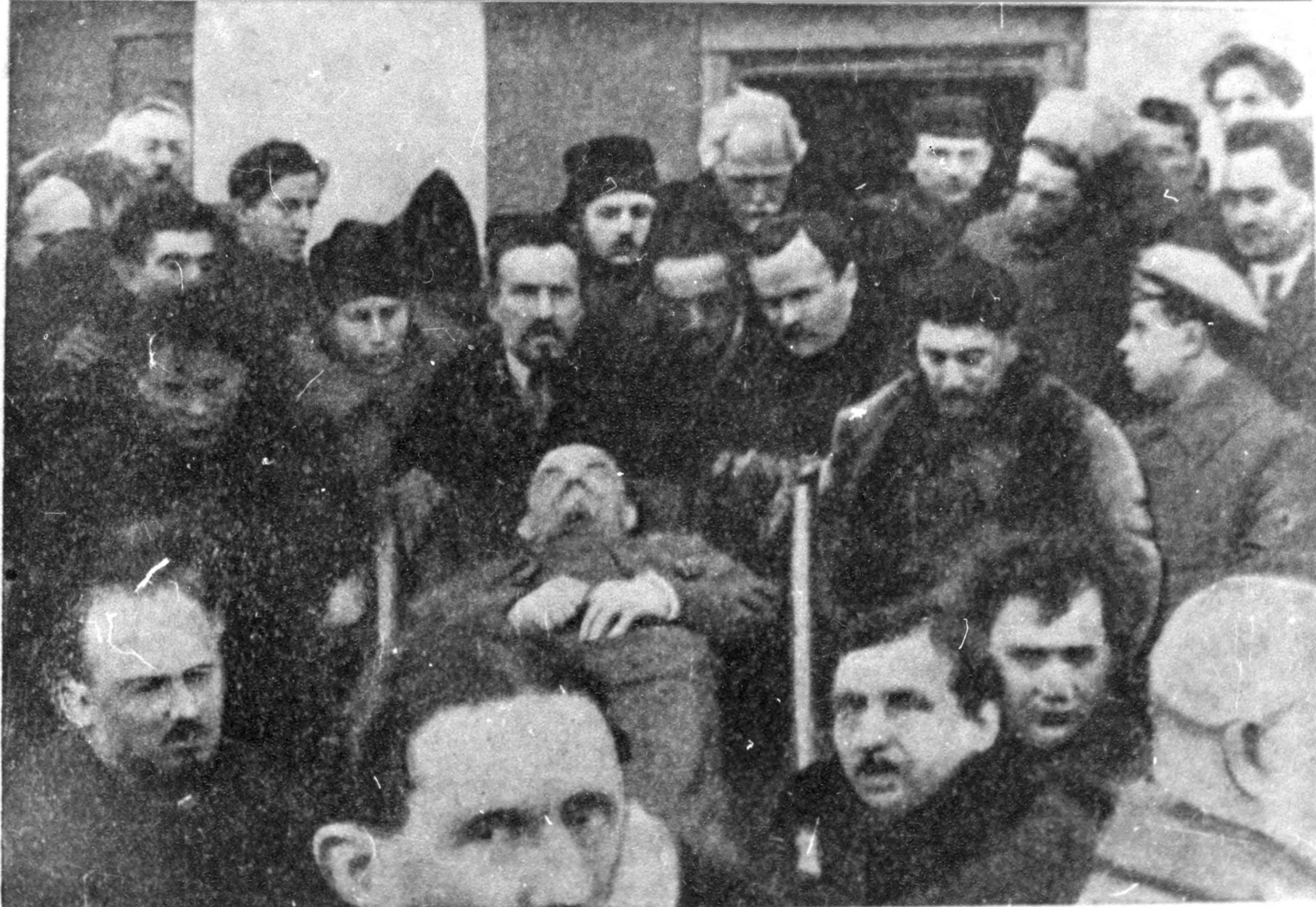
The death of Lenin, 1924: a power vacuum
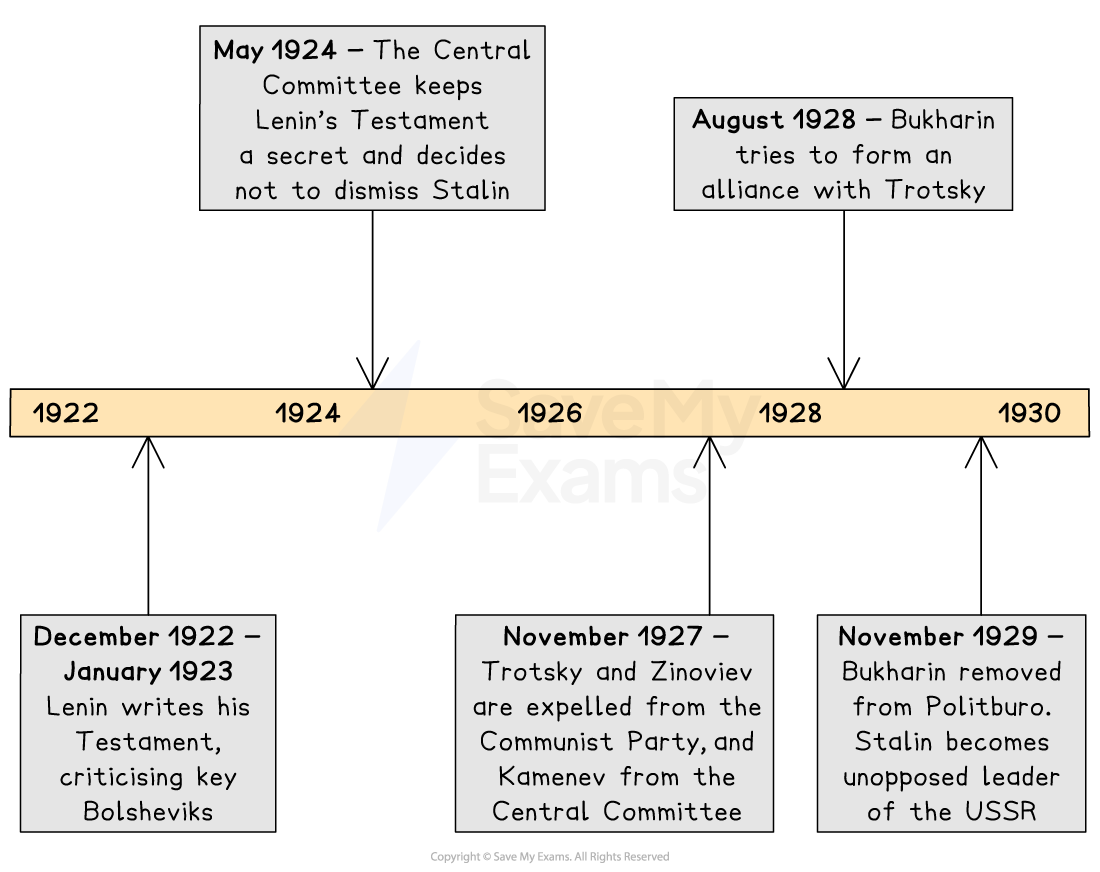
Lenin's decline
Lenin's health declined before his death, leaving the Party without clear leadership
He suffered a major stroke in May 1922
A further stroke in March 1923 left him unable to speak or lead the Party actively
Lenin died on 21 January 1924
There was no agreed system for choosing a successor
Real power lay with the Communist Party, not the state
This made control of senior Party posts the main battleground
Stalin and Lenin's legacy
Stalin moved quickly to present himself as Lenin's closest disciple
Lenin's body was embalmed and placed in a mausoleum
This helped launch a cult of Lenin
Stalin took a leading role at the funeral and linked himself to Lenin's legacy
Trotsky was absent from the funeral:
This damaged his standing as a potential heir
He was recovering from an illness
He claimed that Stalin had sent him a telegram with a false date for the funeral to discredit him
The tools Stalin inherited
The contest was shaped by Lenin's one-party state
The 1921 ban on factions meant organised opposition could be branded as disloyalty
Democratic centralism required members to obey once the leadership had made a decision
Stalin already held the post of General Secretary, created in April 1922
Examiner Tips and Tricks
Be precise with chronology. Lenin’s strokes from 1922 created a power vacuum, but his death in January 1924 opened the struggle.
Remember that power lay with the Party, not the government. Strong answers explain why control of Party posts mattered more than holding a state office.
Lenin’s Testament: why was it suppressed?
What the Testament said
Between late 1922 and early 1923, Lenin dictated his last political document, known as his Testament
It judged the main Bolshevik leaders
It also set out Lenin’s concerns for the Party’s future
The Testament criticised every leading contender
Trotsky was judged as the most able, but too self-assured and too focused on administration
Zinoviev and Kamenev were criticised for failing to back the October seizure of power
Bukharin was praised as the Party's favourite, but his understanding of Marxist theory was questioned
Why Stalin was vulnerable
A postscript added in early 1923 attacked Stalin directly
Lenin called Stalin too rude
He urged comrades to remove him as General Secretary
This followed a row in which Stalin had insulted Lenin's wife, Krupskaya, by telephone
Why was it suppressed?
After Lenin's death, the leadership choice not to publish the Testament
It was read privately to senior figures at the Party Congress in May 1924
It was not made public
The Testament was buried partly because it criticised everyone
Zinoviev and Kamenev argued for shelving it to protect Stalin
Stalin offered to resign as General Secretary, but the offer was declined and he kept the post
A clever move that made him appear benevolent
Suppression protected Stalin
It allowed him to survive the one document that could have ended his career
It also made him appear humble and loyal to the Party
Examiner Tips and Tricks
You do not need to memorise the wording of the Testament. Know Lenin’s judgement of Stalin and Trotsky, and why the document was suppressed.
The key point is that the Testament was buried because it criticised all the leaders, not Stalin alone. Rivalries between the contenders mattered as much as Lenin’s attack on Stalin.
Contenders for power by 1924: Trotsky, Stalin, Zinoviev, Kamenev and Bukharin
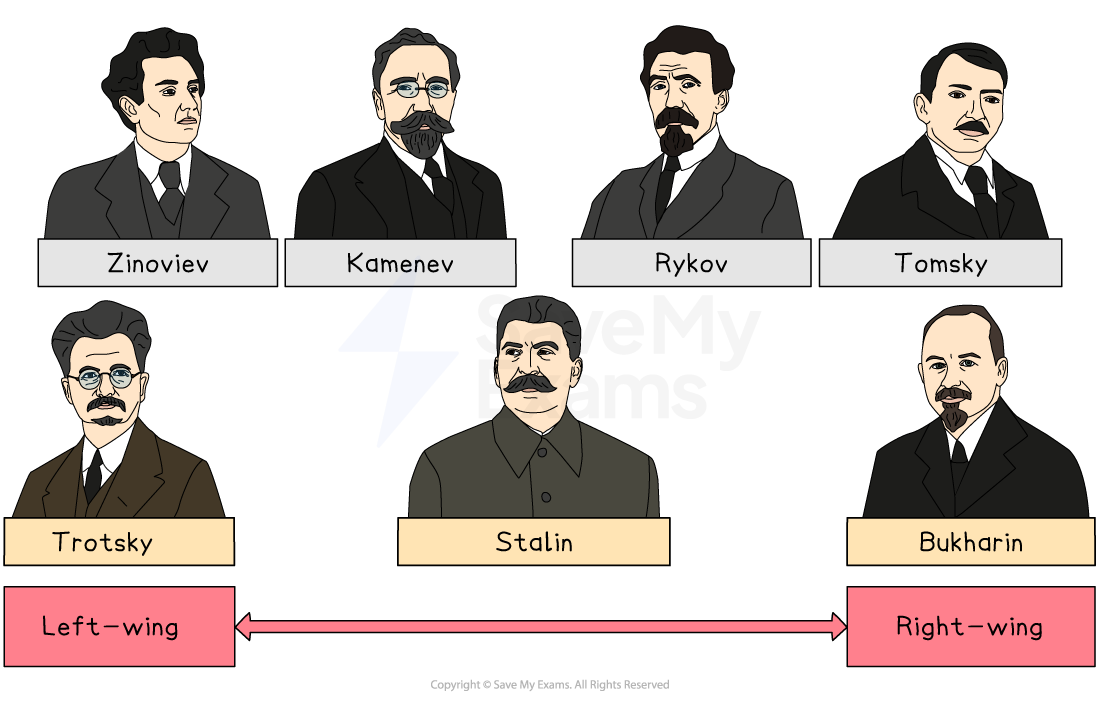
After Lenin's death, the Party split broadly into a left wing and a right wing
Left wing:
Supported War Communism
Wanted rapid industrialisation
Believed in the 'permanent revolution', an idea that the USSR needed to spread communism across the world
This was unpopular within the Party
Right wing:
Defended the New Economic Policy
Believed in 'Socialism in One Country', meaning communism should be strengthened inside the USSR before spreading it anywhere
This was more popular as it promised stability and national self-reliance
The Left
Leon Trotsky
Trotsky was one of the strongest contenders on paper
He was a brilliant speaker and writer
He had organised the October Revolution
He had built the Red Army and motivated troops during the Civil War
His theory of permanent revolution weakened him
He argued that socialism in Russia needed revolution abroad to survive
This looked risky and unrealistic to many Party members
Trotsky had serious political weaknesses
He was distrusted as a latecomer to Bolshevism
Some feared he could become a military strongman
He often seemed arrogant towards other senior figures
He also underestimated Stalin
He claimed Stalin had sent him the wrong funeral date so that he missed Lenin’s funeral
His failure to take Stalin seriously damaged his chances
Grigori Zinoviev and Lev Kamenev
Zinoviev and Kamenev were senior Bolsheviks with strong Party positions
Zinoviev controlled the Party in Petrograd
Kamenev controlled the Party in Moscow
Zinoviev also led the Comintern
Both were experienced and well-connected
However, both were weakened by their public hesitation over the October seizure of power in 1917
Their alliances shifted during the power struggle
They first sided with Stalin against Trotsky
They later moved left
In 1926, they joined Trotsky in the United Opposition
The Centre
Joseph Stalin
Stalin held dull but powerful Party posts
His most important post was General Secretary
He used it to control appointments
He placed loyal supporters in key positions
Rivals underestimated him
They dismissed him as a grey administrator
This allowed him to build strength unnoticed
Stalin had no reputation as a major theorist
He presented himself as practical and unifying
This helped hide how strong his position had become
The Right
Nikolai Bukharin
Bukharin was the Party’s leading theorist and editor of Pravda
He was popular and widely respected
He defended the New Economic Policy
He supported a gradual route to socialism
Bukharin’s weakness was his lack of a personal power base
He had no control over the Party machine
He leaned towards Stalin
He trusted Stalin too much
Alexei Rykov and Mikhail Tomsky
Rykov and Tomsky were important figures on the Right
Rykov succeeded Lenin as head of government, or Chairman of Sovnarkom
Tomsky led the Soviet trade unions
This gave the Right support among organised workers
Both backed Bukharin and the NEP
Both fell with him when Stalin turned against the Right
Examiner Tips and Tricks
Sort the contenders by strengths and weaknesses, not biography. An answer that simply tells each man’s career will score less than one that explains why each was vulnerable.
Trotsky is the clearest example. His talents were obvious, but his arrogance, outsider past and failure to take Stalin seriously all counted against him.
How did Stalin become leader? Alliances, ideology and political skill
Political skill and the Party machine
Stalin's greatest advantage was his control of Party administration
As General Secretary, he controlled appointments and promotions
From 1923, the nomenklatura system listed around 5,000 key posts filled with Party approval
Loyal appointees became delegates at party congresses, helping Stalin outvote his rivals
The Lenin Enrolment after 1924 strengthened Stalin further
It brought many new, inexperienced members into the Party
Many owed their place to the system Stalin controlled
This deepened his support base
Alliances: defeating the contenders in stages
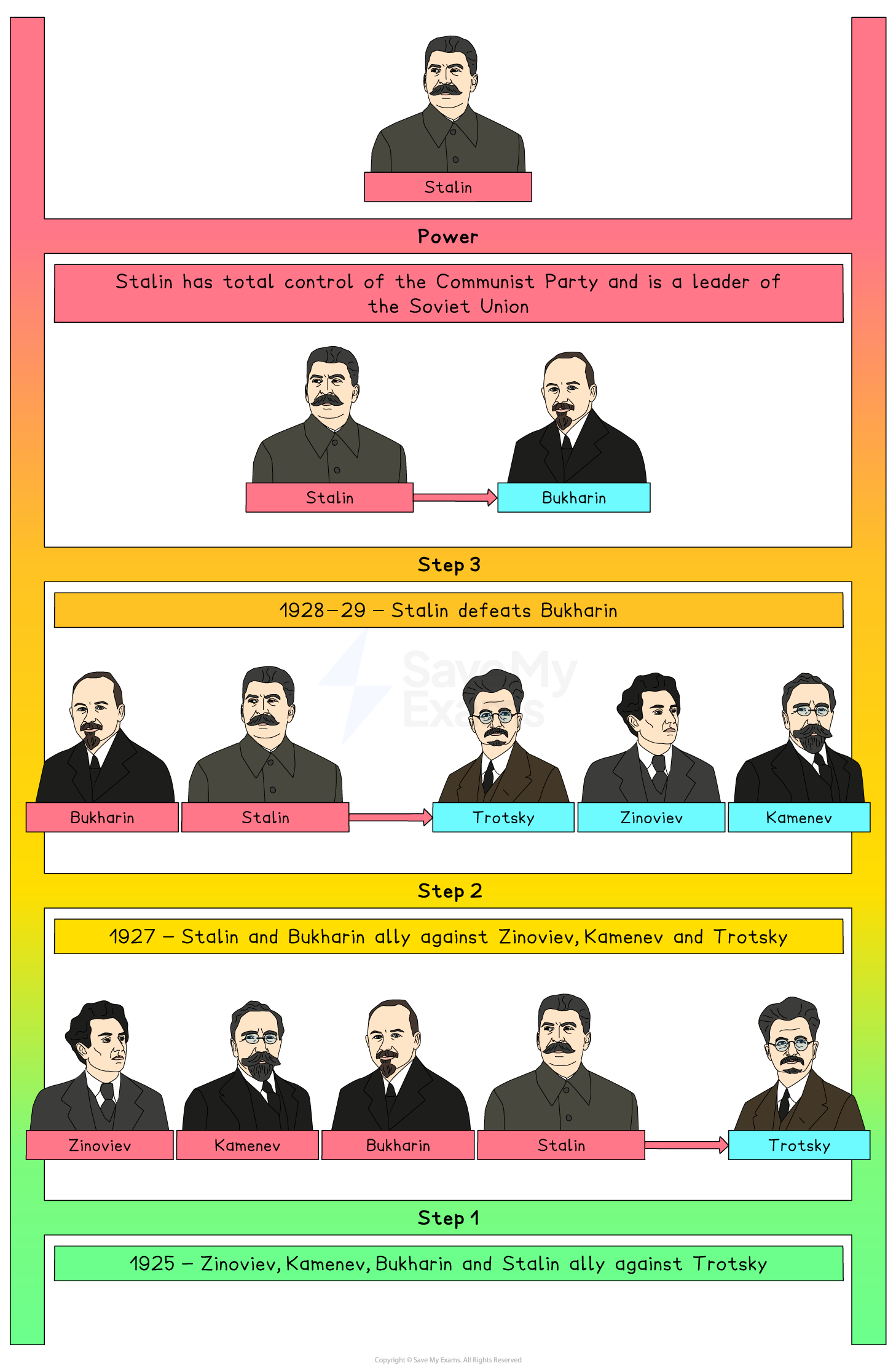
Stalin never faced his rivals all at once
He built temporary alliances
He destroyed one group, then turned on his former partners
Stage 1: Removing Trotsky and the Left
Stalin's first aim was to stop Trotsky from becoming Lenin's successor
After Lenin's death, Zinoviev, Kamenev and Bukharin also saw Trotsky as the main danger
Stalin worked with them because it suited his immediate aim
This allowed him to remove his strongest rival before turning on the others
Trotsky damaged his own position inside the Party
He criticised the lack of democracy inside the Party
Many members saw this as an attack on Lenin's legacy
His criticisms also offended Party officials who had benefited from Stalin's control of jobs and promotions
This made it easier for Stalin to present Trotsky as arrogant, divisive and dangerous
Stalin's control of the Party machine proved decisive at the 1925 Party Congress
Stalin influenced the Party organisation
Zinoviev and Kamenev controlled key party bases in Petrograd and Moscow
At the January 1925 Central Committee plenum, Trotsky lost the vote and was removed as Commissar for War
Stalin then presented himself as moderate
Some wanted Trotsky expelled from the Party
Stalin blocked this
This made Stalin look reasonable while Trotsky looked isolated
Stage 2: Defeating the 'United Opposition'
Trotsky, Zinoviev and Kamenev later joined forces against Stalin as the 'United Opposition'
Zinoviev and Kamenev now agreed with Trotsky that the NEP should end and rapid industrialisation should begin
They also shared his criticism of the way the Party was being run
The alliance put them in direct conflict with Bukharin
Bukharin supported continuing the NEP
This allowed Stalin to work with the Right against them
The creation of the United Opposition in 1926 gave Stalin a new opportunity
Zinoviev and Kamenev looked inconsistent because they had previously helped attack Trotsky
Their criticism of Party policy allowed Stalin to accuse them of forming a faction
Factions had been banned at the Tenth Party Congress in 1921
Stalin used Party discipline to crush the opposition
Zinoviev and Kamenev were removed from their Party positions
In 1927, Zinoviev, Kamenev and Trotsky were expelled from the Party
Zinoviev and Kamenev later admitted they had been "wrong" and were allowed back in
Trotsky refused to make the same compromise
In 1928, he was sent into internal exile in Kazakhstan
In 1929, he was expelled from the Soviet Union
He later lived in Turkey, France, Norway and Mexico, where he continued to attack Stalin's rule
Stage 3: Removing Bukharin and the Right
Once the Left had been defeated, Stalin moved against Bukharin
Bukharin and the Right Communists had supported the NEP
Stalin had worked with Bukharin while it helped him defeat Trotsky, Zinoviev and Kamenev
By 1927-1928, Bukharin was the last major rival standing in Stalin's way
Bukharin was easier to defeat than Trotsky
He did not control the Party organisation
He could not command votes at Party Congresses in the way Stalin could
His defence of the NEP became a weakness as economic problems grew
The crisis of 1927-1928 gave Stalin the chance to abandon the NEP
Poor relations with foreign countries made many Soviet leaders fear war
A poor harvest in 1927 raised fears about food supply
Stalin argued that the Soviet Union had to industrialise quickly and take firmer control over grain
Stalin used grain seizures to reject Bukharin's approach
He travelled to Siberia
He ordered the police to seize grain from peasants accused of hoarding
This became known as the Urals-Siberia method
The Urals-Siberia method marked a clear shift
It broke the rules of the NEP
It showed Stalin's shift towards coercion
By 1929, Bukharin had been defeated
He was removed from his leading post
He was expelled from the Politburo
Stalin had now defeated the Left, the United Opposition and the Right
The power struggle ended with Stalin as the dominant figure in the Soviet leadership
Ideology: Socialism in One Country
Stalin championed Socialism in One Country against Trotsky's permanent revolution
It promised to build socialism inside the USSR
It did not depend on revolutions abroad
This message appealed after years of war and upheaval
It offered reassurance
It created a sense of national pride
It made Trotsky’s reliance on foreign revolution look risky and even unpatriotic
Stalin also used the economic policy tactically
He defended the NEP alongside the Right to defeat the Left
He then adopted the Left’s call for rapid industrialisation to defeat the right
Examiner Tips and Tricks
Questions on Stalin’s rise are common. Examiners expect you to explain how he outmanoeuvred his rivals through alliances, ideology and his position as General Secretary, not just describe what happened.
Notice how Stalin used policy positions tactically. He defended the NEP to beat the Left, then dropped it to beat the Right. Showing this flexibility is a mark of a strong answer.
What was the main factor that allowed Stalin to take power?
This question asks which factor mattered most
Strong answers weigh several factors against each other
The five factors below are not in a fixed order of importance
Factor 1: Control of the Party machine
Stalin's grip on the Party administration gave him a major advantage
As General Secretary, he controlled appointments
He controlled the nomenklatura
He helped choose Congress delegates
This allowed him to outvote his opponents
Through the Lenin Enrolment, he helped fill the Party with loyal members
Key historian
"In 1934, Stalin’s power derived from his position as head of the Party apparatus. Decisions flowed from the Politburo through the Party apparatus and then to the economic ministries, the secret police, the army and the various organs of government. By 1939, the Party apparatus could no longer control Stalin. Stalin had achieved a personal authority independent of any single institution."
Adapted from D. Christian, Imperial and Soviet Russia (1997)
Looking back from the 1930s, Christian traces Stalin’s authority to the Party apparatus
This supports the case that control of the Party machine was central to his rise
Factor 2: Stalin's political skill and tactics
Stalin built and discarded alliances in stages
His rivals never faced him together
He drew his opponents into temporary partnerships
He then turned on each group in turn
He used policy flexibly
He backed the Right to beat the Left
He then supported rapid industrialisation to beat the Right
Factor 3: The appeal of 'Socialism in One Country'
Stalin's programme offered something his rivals could not
'Socialism in One Country' promised stability
It offered self-reliance to a Party tired by years of war
Trotsky's permanent revolution looked risky because it depended on revolutions abroad
Key historian
"Stalin’s most important contribution to communist theory was in his advocacy and adoption of the notion of ‘Socialism in One Country’. This was not a particularly insightful concept, since it represented little more than a theoretical justification of actual developments in the USSR. Nor was it Stalin who originally devised the concept. The policy basically justified attempts to build socialism in a country that Lenin had admitted was not, in itself, ready for socialism. The policy thus contradicted classical Marxism. But it appealed to Soviet citizens. Most were tired of wars and revolution and wanted stability."
Adapted from L. Holmes, Communism, A Very Short Introduction (2009)
Holmes argues that Socialism in One Country mattered less as theory than as a message
It appealed to a population that wanted stability
This supports the case that ideology helped Stalin win support
Factor 4: The weaknesses and mistakes of Stalin's rivals
Stalin's success was partly the result of his rivals' failures
Trotsky's arrogance, ill health and failure to use the Testament weakened the Left
The contenders feared each other more than Stalin
They only united once it was too late
Factor 5: The structure of the one-party state
Lenin's system made a bureaucratic strongman hard to resist
His death in 1924 created a genuine vacuum
There was no agreed way to choose a successor
The ban on factions and democratic centralism let Stalin brand opposition as disloyal
Examiner Tips and Tricks
This is a judgement question, so weigh the factors against each other rather than listing them. The factors interact: Stalin’s ideas reached the Party through the machine he controlled, and his rivals’ mistakes gave that machine room to work.
There is no fixed right answer. Decide which factor you find most convincing, support it with evidence, and acknowledge the strength of the others.

Unlock more, it's free!
Join the 100,000+ Students that ❤️ Save My Exams
the (exam) results speak for themselves:

Was this revision note helpful?
