The Impact of the Crimean War on Russia, 1853–1856 (AQA A Level History: Component 1: Breadth study): Revision Note
Exam code: 7042

Summary
Russia entered the Crimean War in 1853, seeking to expand its influence over Ottoman-controlled territory in the Balkans
The intervention of Britain and France turned a regional conflict into a European war Russia was poorly equipped to fight
Russia suffered major defeats at Balaclava in October 1854 and Inkerman in November 1854
The fortress of Sevastopol fell in September 1855
The Treaty of Paris (1856) barred Russian warships from the Black Sea in peacetime
The war exposed Russia’s military weaknesses, especially in weaponry, supply and technology
It also increased pressure for reform
Trade was disrupted, peasant unrest escalated and the intelligentsia intensified calls for change
By 1855, the political case for resisting change had weakened significantly
Historians debate whether the Crimean War made reform unavoidable or accelerated pressures that already existed before 1853
Why was Russia defeated in the Crimean War?
Origins of the conflict
In the mid-nineteenth century, the Ottoman Empire controlled territory across the Middle East, Anatolia and the Balkans, including the strategically vital Black Sea Straits
The Sultan had struggled to maintain authority over Christian minorities since the 1820s
Nicholas I saw this weakness as an opportunity to expand Russian influence
He claimed the role of Protector of Orthodox Christians to justify pushing Russian influence southward towards Constantinople and the strategically vital Black Sea Straits
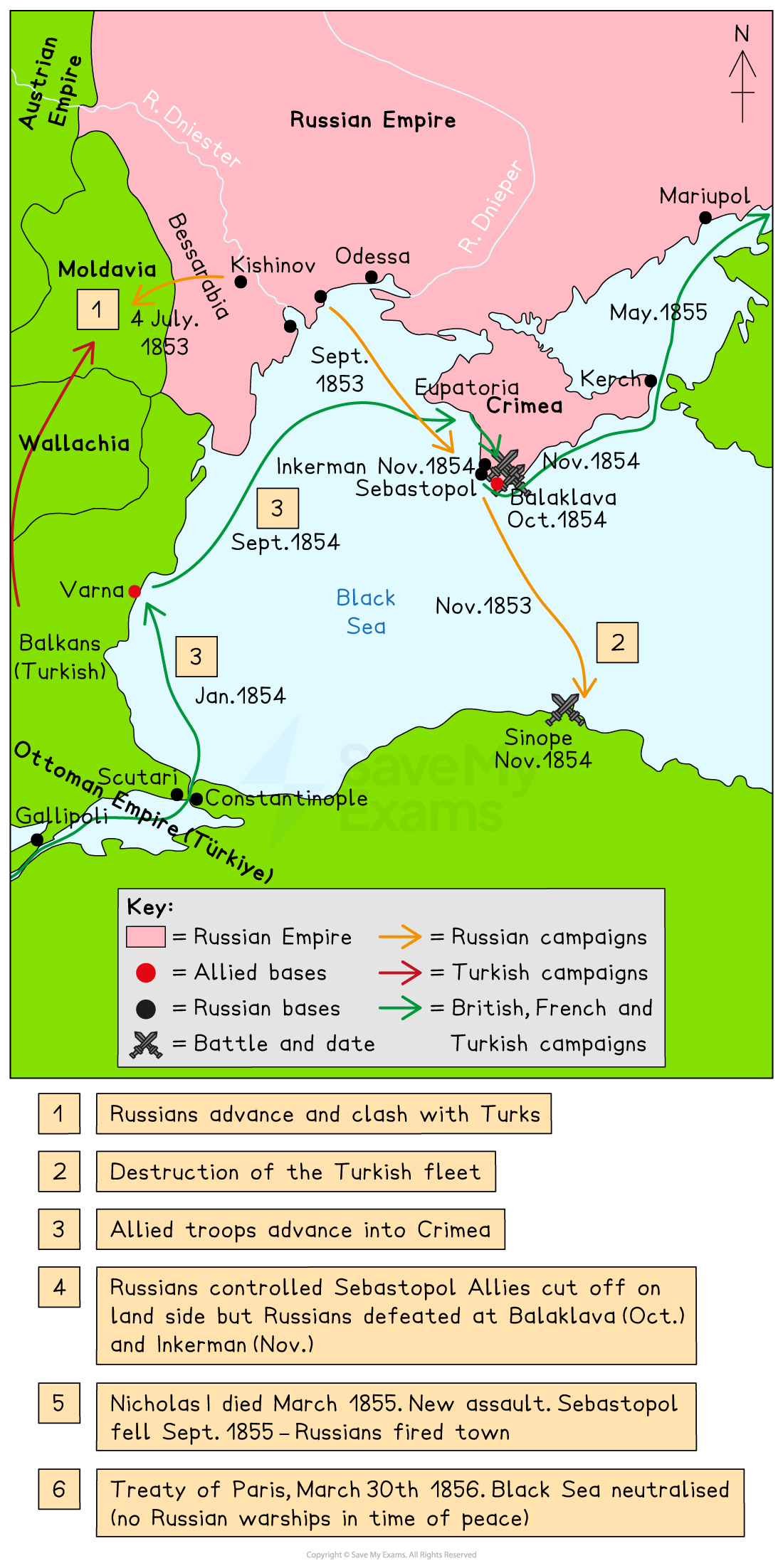
In Summer 1853, Nicholas sent Russian forces into Moldavia and Wallachia, Ottoman-controlled principalities north of the Danube
The Ottoman Empire responded by declaring war on Russia in October 1853
In November 1853, Russia sank the Turkish Black Sea Fleet at Sinope Bay
The scale of the Russian victory alarmed Britain and France
Britain and France entered the war to protect their strategic and trading interests
They wanted to prevent Russia from dominating the Ottoman Empire and the Black Sea
A joint force of around 60,000 allied troops landed in the Crimea
They besieged Russia’s main naval base at Sevastopol
Russia's military failures
Russia entered the war confident in its military strength, but the campaign rapidly exposed how far it had fallen behind
The Russian conscript army was large
However, it lacked the tactical flexibility, equipment and organisation of the British and French units
Poor communications made it difficult to move men, weapons and supplies to the front
A cholera epidemic added to the death toll on both sides
Russian troops were already poorly supplied before disease took hold
Weak logistics made the impact of disease even more damaging
Two engagements became symbols of Russia's military failure
Balaclava (October 1854):
Russian attempts to break the allied siege lines failed
The battle exposed weaknesses in Russian cavalry tactics and command coordination
Inkerman (November 1854):
A major Russian assault was repulsed with heavy casualties
Numbers alone could not compensate for inferior equipment and poor organisation
Nicholas I died in March 1855, reportedly telling his son and heir:
"I hand over to you my command, unfortunately not in as good order as I would have wished."
Nicholas I to Alexander II, March 1855
Sevastopol fell to the allied forces in September 1855 after a siege lasting nearly a year
The Treaty of Paris (March 1856) concluded the war
It barred Russian warships from the Black Sea in peacetime
For Russia, this became the most lasting humiliation of the war
Examiner Tips and Tricks
The Crimean War is frequently tested as part of broader questions about why Russia changed in the later nineteenth century. Do not just narrate the events of the war. Show what the defeats revealed: the weakness of the serf-based conscripted army, the absence of railways and the culture of complacency under Nicholas I.
The best answers connect specific military failures to specific pressures for reform. Examiners reward analysis, not a list of what happened.
Military, economic & political weaknesses exposed by the Crimean War
The Crimean War exposed multiple weaknesses across the Russian Empire
Outdated technology and weaponry
Russia's military equipment was far behind that of its opponents
In some units, only one musket was issued per two Russian soldiers
This reflected Russia’s industrial underdevelopment and failure to modernise the army’s supply chain
The Russian navy still used wooden sailing ships
British and French vessels were increasingly steam-powered and technologically superior
This gave the allies a decisive naval advantage
The inshore fleet at Sevastopol included rowing boats powered by conscripted serfs
Illustrating how far Russia lagged behind the industrial powers
Transport failure
Russia had no modern railway network, which proved a decisive liability
It took far longer to move troops and supplies to the Crimean front than it took Britain and France to ship materiel from their home ports
Equipment arrived slowly and in insufficient quantities
Sevastopol was chronically undersupplied throughout the siege
Russia's vast size was a strategic weakness, not a strength
Without modern infrastructure, the regime could not move men, weapons or supplies quickly across the empire
Conscript serf-army
Russia's army was built on serfs conscripted for 25-year terms
It was designed for internal order and mass manoeuvre, not flexible modern warfare
Serfs made poor professional soldiers
Many were illiterate
They lacked individual initiative
They were commanded through a rigid hierarchy that discouraged independent judgement
The system produced no effective trained reserve
Men who had served 25 years were too old to fight again
Those yet to be conscripted had no military training
Many reformers concluded that modernising the army was inseparable from reforming serfdom
The two were structurally linked
Reform of one required reform of the other
Inadequate leadership and political complacency
Russian officers were appointed through court connections, not military ability
Command coordination broke down repeatedly at Balaclava and Inkerman
Officers were reluctant to show initiative or challenge orders
Autocratic culture punished independent thinking
This produced commanders who waited for instructions rather than responding to events
The repressive reign of Nicholas I had made it politically dangerous to discuss Russia's weaknesses openly
Criticism of the military was treated as criticism of the state itself
The regime could not reform what it had been unable to honestly assess
The defeat came as a genuine shock to the government, not just to outsiders
Economic and social impact
The war placed severe strain on an economy already limited by the serf system
Black Sea trade was disrupted throughout the campaign
This negatively impacted the landowning and merchant classes
The burdens of wartime supply fell disproportionately on serfs
This fuelled peasant unrest that escalated during and after the conflict
The weaknesses exposed by the Crimean War encouraged liberal members of the intelligentsia to criticise the autocracy more openly
Writers, officials and liberal nobles called for modernisation across railways, industry, education and the treatment of the serf majority
The accession of Alexander II in 1855 brought a new generation of liberal-minded officials who were determined to act on these pressures
Examiner Tips and Tricks
Don’t list the weaknesses separately. Explain how they were connected. The absence of railways made it harder to supply the conscripted army. The conscripted army depended on serfdom, and serfdom limited the economic development that railway construction required. Showing this chain of cause and effect is what separates a strong answer from a mediocre one.
Be specific. “One musket for every two soldiers” is more analytically useful than “Russia was militarily backward".
Why did the Crimean War force change in Russia?
Russia's defeat was not just a military setback
It became a public failure that seriously damaged the credibility of Nicholas I’s system of government
It exposed weaknesses that the regime could no longer ignore
The key debate is how decisive the war's role was in forcing the changes that followed
Some historians see the war as the direct cause of reform
Others argue that it accelerated pressures that had already been building before 1855
The war as a decisive catalyst for change
The fall of Sevastopol destroyed the credibility of Nicholas I's regime
Nicholas had built his reign on military strength as the guarantee of stability and proof of autocratic power
Defeat made Russia’s structural weaknesses visible and undeniable
The embarrassment was felt both at home and across Europe
Military defeat created a direct chain of logic running to reform
Modern warfare required a professional army, not a serf-conscript force
A professional army required railways; railways required industrial development; industrial development required free labour
This logic led directly to the case for emancipating the serfs
The Treaty of Paris transformed the pressure for reform from a political preference into a strategic necessity
The Black Sea neutralisation clause removed Russia's ability to defend its southern coastline
Restoring that capacity required naval modernisation, which required economic development that serfdom made impossible
Russia faced a strategic deadline
It needed to rebuild its credibility as a European power before its rivals could exploit its weaknesses further
The war as an accelerant of pre-existing pressures
The weaknesses the war exposed were not created by it
Serfdom's incompatibility with economic modernisation had been identified by officials and intellectuals before 1853
The intelligentsia had been calling for reform since the 1830s
The war made these arguments more urgent, rather than inventing them
Alexander II's own character was an independent factor
He had been exposed to more liberal ideas than his father during his upbringing
He was less committed than Nicholas I to repression as the only answer to Russia’s problems
The war gave him political urgency and a mandate for reforms he may have pursued in any case
The reform route was shaped by domestic politics as much as by military logic
The 1861 emancipation settlement included redemption payments and kept the mir structure in place
These features reflected the interests of the nobility, not the logic of military defeat alone
This shows that the war created pressure for reform, but did not determine exactly what reform would look like
What the Crimean War set in motion
The war generated pressure that Alexander II translated into four major reforms:
The emancipation of 51 million serfs (1861), ending the social basis of the serf-conscript army
Elected local councils, the zemstva, established in 1864
A reformed court system introducing trial by jury (1864)
Military conscription reform (1874), replacing the 25-year serf-conscript term with shorter universal service
These reforms are covered in full in the next revision note
Examiner Tips and Tricks
Don’t describe what Alexander II went on to reform. That answers a different question. This question, 'Why did the Crimean War force change in Russia?' asks about compulsion: what specifically did the war create that made reform impossible to defer?
Separate the military, economic and political pressures the war generated and connect each to a specific reform agenda. Then acknowledge what pre-dated the war. That is what allows you to assess how decisive the war’s role actually was, rather than simply asserting it was a turning point.
The reforms themselves belong to the next spec point. Keep this section focused on pressure and compulsion, not on what the reforms looked like.

Unlock more, it's free!
Join the 100,000+ Students that ❤️ Save My Exams
the (exam) results speak for themselves:

Was this revision note helpful?
