Stalin’s Dictatorship: Terror, the Secret Police and the Gulag (AQA A Level History: Component 1: Breadth study): Revision Note
Exam code: 7042
Summary
A totalitarian state seeks total control
Stalin built one using ideology, the police, propaganda and terror
The secret police kept one purpose under changing names: Cheka, GPU, OGPU, then NKVD by 1934
The Gulag grew into a vast camp network
It held around one million prisoners by 1934
Show trials used forced confessions and fixed verdicts to display the Party's power
Three NKVD chiefs ran the terror in turn
Yagoda and Yezhov were later destroyed by the system they helped run
Historians debate whether terror was driven mainly by Stalin’s personal dictatorship or by the one-party system Lenin built
Volkogonov argues terror flowed from Stalin’s personal command
Figes argues terror grew from the Leninist tradition Stalin inherited
Stalin and totalitarianism: how total was his control?
What is totalitarianism?
In general, a totalitarian state tries to control every part of life, not just government
It controls politics through a single ruling party
It controls ideas through one official ideology
It treats rival parties, independent organisations and criticisms as threats
In Stalin's Russia, this meant total control by the Communist Party
The only accepted ideology was Marxism-Leninism, as Stalin interpreted it
Opposition was treated as betrayal, not normal political disagreement
Public life, private life, culture, education and the economy were all expected to serve the state
The pillars of Stalin's control
Stalin's dictatorship rested on connected tools:
The secret police used surveillance and removed suspects
Propaganda and the cult of personality presented Stalin as an infallible leader
The Gulag and fear of arrest enforced obedience through terror
How total was it?
By the late 1930s, Stalin's power was personal, not institutional
Orders flowed from him through the Party, police and army
By 1939, the Party could no longer control him
However, control was never complete
Local bureaucracy was inefficient
Local officials could slow down central demands
In the Ryutin affair of 1932, Stalin reportedly wanted Ryutin executed, but the Politburo did not approve this
This suggests Stalin’s control was not yet absolute in the early 1930s
Examiner Tips and Tricks
Use “totalitarian” carefully. It describes the regime’s aim for total control, not proof that control was complete.
The best answers weigh the reach of Stalin’s power against its limits, such as local inefficiency and the rare times he was outvoted.
The development of the Soviet secret police: Cheka to NKVD
The secret police was the core instrument of Soviet control from 1917
It changed names often
Its purpose stayed the same: protecting the Party
How the secret police evolved
Organisation | Years | Head | Role |
|---|---|---|---|
Cheka All-Russian Extraordinary Commission | 1917-22 | Dzerzhinsky |
|
GPU State Political Directorate | 1922-23 | Dzerzhinsky |
|
OGPU Unified State Political Directorate | 1923-34 | Dzerzhinsky, then Menzhinsky |
|
NKVD People's Commissariat for Internal Affairs | 1934-41 | Yagoda, Yezhov, Beria |
|
Merging the police into the NKVD in 1934 tightened Stalin's control
Policing, state security and the camps now sat under one body
The NKVD became the main engine of terror in the 1930s
After 1941, the secret police continued under new names
It became the NKGB
Then the MGB
From 1954, the KGB
Examiner Tips and Tricks
Track the names in order: Cheka, GPU, OGPU, NKVD. Treat them as one continuous institution under changing labels, not as separate creations.
The key point is continuity of purpose, with growing scale and tighter central control over time.
The Gulag system: forced labour camps in the Soviet Union
What was the Gulag?
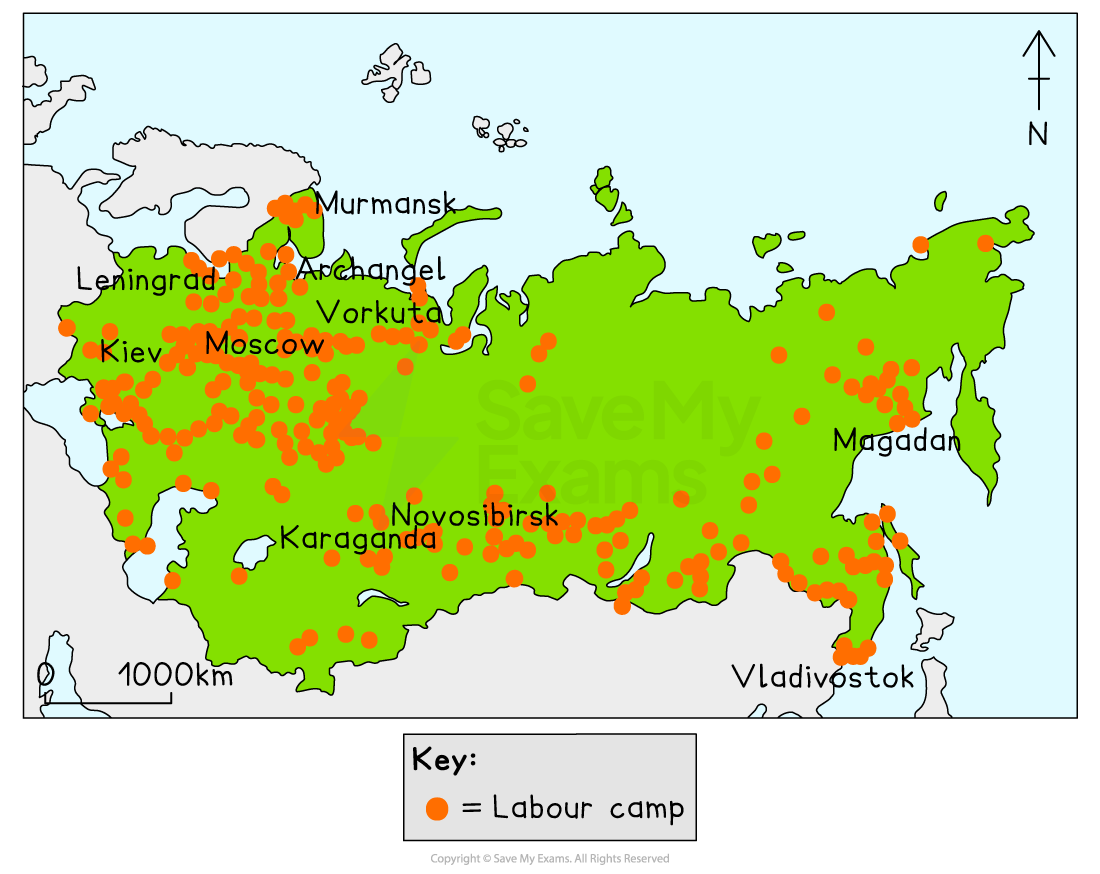
The Gulag was the network of Soviet forced labour camps
The name is an acronym for the Main Administration of Corrective Labour Camps
It was a system of thousands of camps, not a single place
How the system grew
Camps began under the Cheka
They were used to hold "class enemies"
By 1929, the camps were filling with the regime's 'enemies'
Kulaks and NEPmen, swept up by collectivisation and dekulakisation
"Wreckers", "saboteurs" and "bourgeois specialists"
Political opponents
Ordinary criminals
Yagoda built new camps of around 60,000 prisoners each
Many were in Siberia and the north
Prisoners mined timber, gold, nickel, coal and oil
By 1934, the camps held around one million people
Purpose and conditions
The Gulag both punished enemies and supplied unpaid labour
Prisoners built major projects such as the White Sea Canal
Conditions were severe
Hunger, disease, cold and high death rates were common
Examiner Tips and Tricks
Show that the Gulag served both repression and the economy. It was not just a prison system: it punished enemies while supplying forced labour for the state.
Show trials in the USSR: justice or performance?
A show trial was a public trial staged for propaganda
Stalin used them to remove his opponents publicly
Confessions came from torture, threats and holding their families ransom
Verdicts were often fixed in advance and reported widely in the press
The major show trials
Trial | Year | Key Figures | Outcome |
|---|---|---|---|
Shakhty trial | 1928 | 53 mine engineers | 5 executed, 44 imprisoned; the first Stalinist show trial |
Industrial Party trial | 1930 | Leading industrialists | Convicted of planned sabotage |
Metro-Vickers trial | 1933 | British engineers | Found guilty of ‘wrecking’ |
First Moscow Trial | 1936 | Zinoviev, Kamenev | Executed for an alleged terrorist plot |
Second Moscow Trial | 1937 | Radek, Pyatakov | Convicted of sabotage and spying |
Third Moscow Trial | 1938 | Bukharin, Rykov | Executed; the last of the Old Bolsheviks |
The trials projected Party unity and authority
Confessions to impossible crimes 'proved' that enemies were everywhere
The public format turned terror into political theatre
Examiner Tips and Tricks
The phrase “justice or performance” is the key. Strong answers name the theatrical features: scripted confessions, fixed verdicts and heavy press coverage.
The roles of Yagoda, Yezhov and Beria
Three men led the NKVD in turn
Each shaped terror differently
The three chiefs at a glance
Chief | Years as Head | Key Role | Fate |
|---|---|---|---|
Yagoda | 1934–36 | Built the Gulag; ran the first Moscow trial | Judged too soft; shot in 1938 |
Yezhov | 1936–38 | Drove terror to its height (the Yezhovshchina) | Removed and executed |
Beria | from 1938 | Ended the worst phase; expanded the Gulag | Outlasted Stalin; executed in 1953 |
Genrikh Yagoda (1934-36)
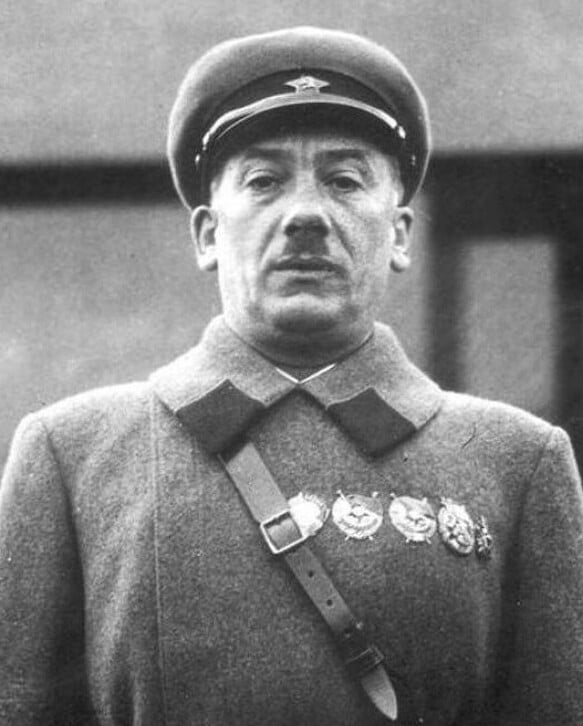
Yagoda was a career secret policeman
He had been in the Cheka from 1920
He became deputy head of the OGPU
He ran the labour camps from 1930 and built the early Gulag network
As NKVD chief he organised the first Moscow show trial in 1936
He was also linked to the murder of the Party leader Sergei Kirov in 1934
Stalin judged him too soft and replaced him with Yezhov
Yagoda was arrested in 1937 as a "Trotskyist conspirator"
He was shot in 1938
Nikolai Yezhov (1936-38)
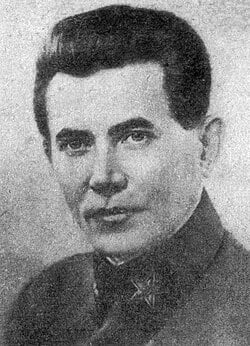
Yezhov led the NKVD at the height of the terror
This period became known as the Yezhovshchina
He pushed the secret police to its most intensive activity
Interrogations became constant
Officers worked in shifts so questioning never stopped
By late 1938, Stalin blamed him for the terror's "excesses"
He was removed
He was arrested and executed, like Yagoda before him
Lavrenty Beria (from 1938)
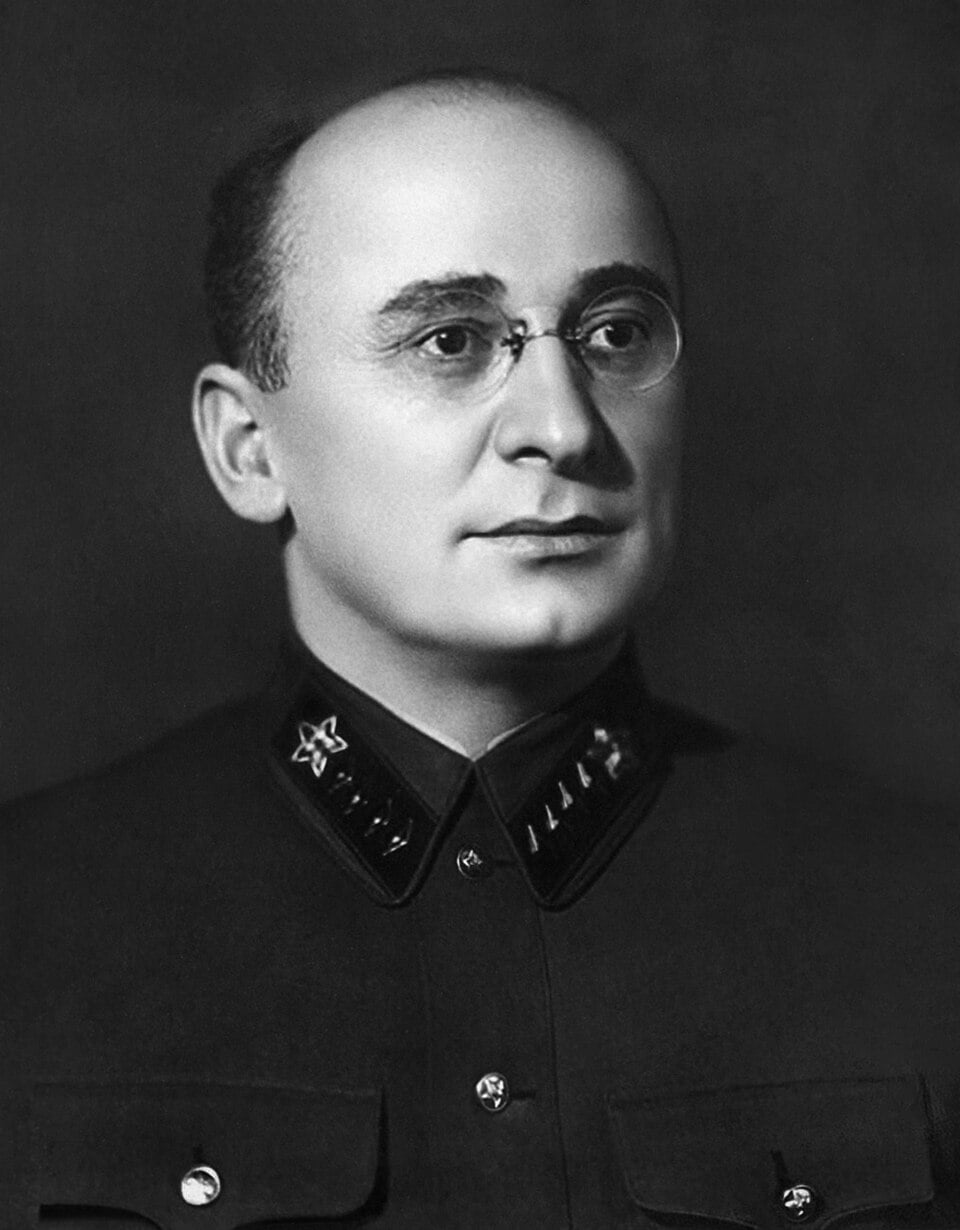
Beria took over in 1938
He ended the most violent phase of terror
He reorganised the secret police to make it more disciplined
He hugely expanded the Gulag during the war and also after 1941
He also ran wartime deportations of whole groups of people
This included the Chechens in 1944
Beria's power was the most far-reaching of the three
It still depended on Stalin's favour
He outlasted Stalin
He was arrested and executed by his colleagues in 1953
What their fate shows
Even those who ran the terror were not safe from it
Both Yagoda and Yezhov were destroyed
Each chief survived only as long as Stalin's favour
Examiner Tips and Tricks
Use the three chiefs to show change over time, not just as a list of names. Yagoda built the camps, Yezhov drove terror to its height, and Beria reorganised it.
The destruction of Yagoda and Yezhov shows how personal and unpredictable Stalin’s power had become.
Who was responsible for terror in the USSR?
Historians disagree over responsibility for Soviet terror
Was Stalin himself mainly responsible?
Or was terror driven by the system he inherited and led?
Stalin's personal dictatorship drove the terror
Terror became a tool of one man's rule
By the late 1930s, Stalin’s power was personal and unchecked
He could aim the secret police at anyone he chose
The NKVD chiefs served and fell at Stalin's command
Yagoda and Yezhov were destroyed once they had served their purpose
Key historian
“Stalin shaped a system founded on an unbeatable, universal ideology, a Party consisting of legions of bureaucrats, a single and almighty leader who was virtually an earthly God ... and total political surveillance by ‘punitive organs’. The anonymous crowd was wrapped in a blanket of ideology and used as an obedient tool ... The individual, in other words, was no more than a tiny cog in the machine that executed the dictator’s will.”
Adapted from D. Volkogonov, The Rise and Fall of the Soviet Empire (1999)
Volkogonov, a Soviet general with archive access, sees terror flowing downwards from Stalin
The phrase “the dictator’s will” places personal responsibility at the centre
The system Lenin built drove the terror
The machinery of terror existed before Stalin
The secret police, one-party rule and the Red Terror all began under Lenin
Stalin expanded a system already built for coercion
His methods continued the Leninist tradition rather than breaking it
Key historian
“Stalin always portrayed his revolution as a continuation of the Leninist tradition ... His drive towards industrialisation, sweeping aside the market and the peasantry, was in essence no different from Lenin’s own drive towards Soviet power which had swept aside democracy. One could argue that the centralised command system was itself an inevitable outcome of the contradiction between a commitment to a proletarian dictatorship and an overwhelmingly peasant country.”
Adapted from O. Figes, A People’s Tragedy, (1996)
Figes places Stalin within a longer Bolshevik story
On this reading, responsibility is shared with the system Lenin created
Stalin used and expanded that system, rather than inventing terror alone
Examiner Tips and Tricks
Address both sides. Lenin built the institutions of terror, but Stalin used them at his own discretion. Strong answers weigh institutional continuity against Stalin’s personal responsibility.

Unlock more, it's free!
Join the 100,000+ Students that ❤️ Save My Exams
the (exam) results speak for themselves:

Was this revision note helpful?
