State Control of the Economy: From the NEP to the Command Economy (AQA A Level History: Component 1: Breadth study): Revision Note
Exam code: 7042

Summary
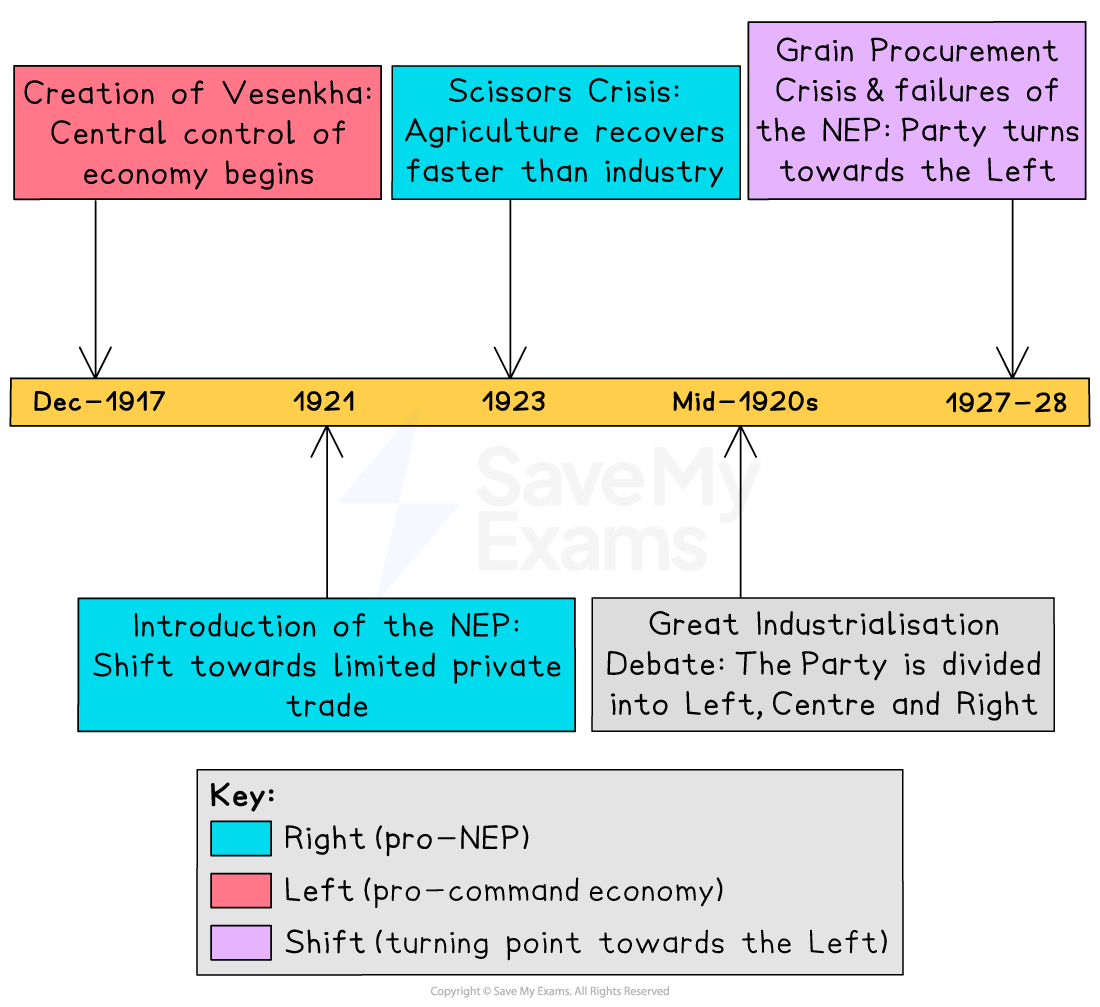
The Vesenkha, set up in December 1917, was the first body to manage Soviet industry centrally
By the mid-1920s, the state had the institutions to plan and direct the economy
Vesenkha managed industry
Gosplan planned the economy from 1921
The Great Industrialisation Debate split the Party over how quickly the USSR should industrialise
The Left wanted rapid state-led industry
The Right wanted to keep the NEP and avoid alienating the peasants
The 1927-28 grain procurement crisis exposed the failure of the NEP to feed the towns reliably
Historians debate whether the command economy was a practical response to crisis or a choice shaped by ideology and politics
The Vesenkha: central economic planning
Soviet leaders began building central economic control soon after taking power
The Vesenkha was the first major body created for this purpose
It set the pattern for the planned economy that later developed
The creation of the Vesenkha
The Vesenkha, or Supreme Council of the National Economy, was set up in December 1917
Its job was to manage industry and finance
It was designed to bring order to a chaotic economy
It marked a shift away from workers' control
Economic power moved towards central state planning
Vesenkha became the most important institution of economic management
The powers of the Vesenkha
The Vesenkha took wide powers over the economy
It reorganised the industry to make it more efficient
It nationalised banks, transport and large-scale industry
It set production targets and directed resources to key sectors
The growth of central planning in the 1920s
By the 1920s, its role had expanded further
It supervised state-run businesses
It helped coordinate long-term economic planning
Gosplan was created in 1921 to plan the economy
From 1925, it drew up the targets that later shaped the Five-Year Plans
By the mid-1920s, the state had both the institutions and the habit of central direction
This existed even while the NEP still allowed private trade
Examiner Tips and Tricks
Do not confuse Vesenkha with Sovnarkom or the Politburo. Vesenkha dealt with the economy, while Sovnarkom and the Politburo had broader political roles.
Keep Vesenkha separate from Gosplan too: Vesenkha managed industry from 1917, while Gosplan planned the economy from 1921 and later helped set Five-Year Plan targets.
Party opinions on the economy: left vs right opposition
After Lenin's death, the Party was divided over how to develop the economy
This became known as the Great Industrialisation Debate
It grew out of weaknesses in the NEP
The roots of the debate: the Scissors Crisis
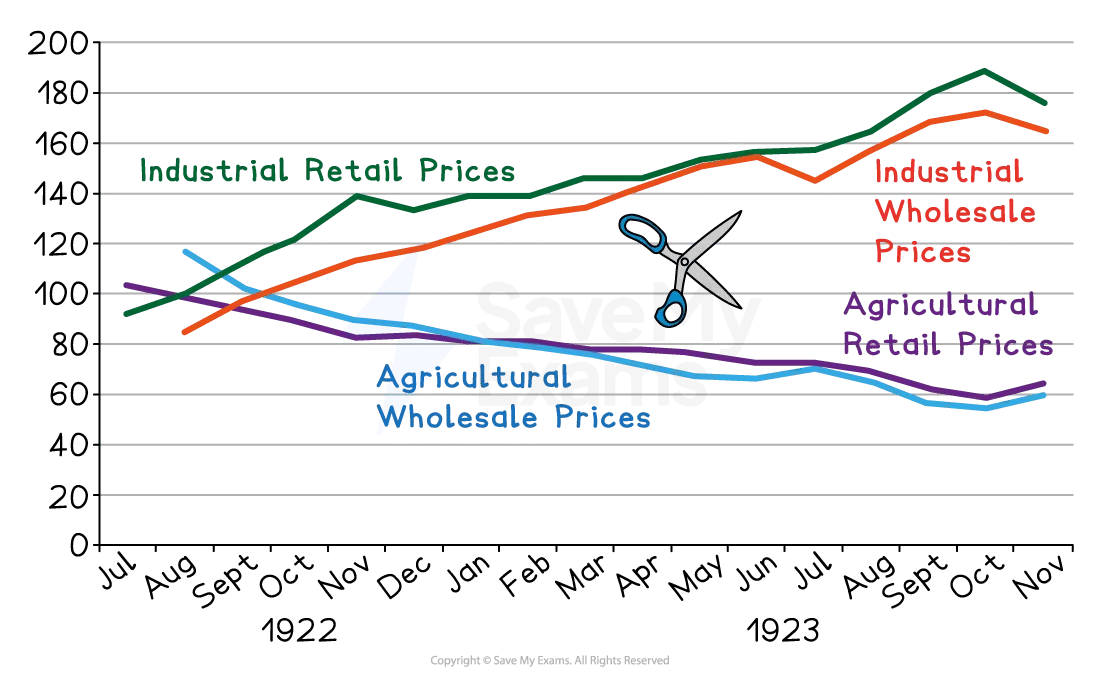
Under the NEP, agriculture recovered faster than industry
Peasants quickly grew more once they could sell their surplus harvest for profit
Industry stayed under state control
Industrial recovery was slower because investment remained limited
This created the Scissors Crisis in 1923
Industrial prices rose
Farm prices fell
Trotsky compared the widening price gap to the blades of a pair of scissors
The crisis damaged trade between the town and the countryside
Manufactured goods became expensive and scarce
Peasants had little reason to sell grain for overpriced goods
Many held grain back
By 1928, production had recovered to around its 1913 levels, but the recovery was uneven
The NEP could not satisfy peasants and townspeople at the same time
Many on the Left argued that socialism could not be built “with capitalist hands”
The Left: the case for rapid industrialisation
The Left wanted rapid, state-led industrialisation
Heavy industry should come first
This would build socialism quickly
The state should use farm profits to fund industry
This was a process of capital accumulation
It meant squeezing the peasantry
The Left accepted that this would cause anger
Its supporters included:
Trotsky
Zinoviev
Kamenev
The Right: the case for continuing the NEP
The Right wanted to keep the NEP going
Private trade and small-scale capitalism would help the economy recover first
The peasants were seen as essential allies
The Right wanted to avoid alienating the peasantry
Its approach is often summed up as building socialism "with capitalist hands"
It was supported by:
Bukharin
Rykov
Tomsky
The Centre: pragmatism
The Centre adopted a flexible strategy
It argued that policy should follow the country's needs, not be a fixed ideology
It backed the NEP until 1927, when growth slowed
Stalin was one of the key supporters of the Centre
Why the debate mattered
The Right won most Congress debates through the mid-1920s
This blocked the Left
It was one reason the Party turned against Trotsky
As economic problems worsened, Stalin's Centre shifted towards the Left
This shift laid the groundwork for the command economy
Examiner Tips and Tricks
A useful way to remember the Left and Right is: “The Left launch, the Right rest.”
The Left wanted rapid industrialisation. The Right wanted to continue the NEP and let the economy recover more gradually.
Why did the USSR adopt a command economy?
By the late 1920s, the NEP was widely seen as inadequate
The Party turned decisively towards full-scale control
The trigger: the grain procurement crisis
By the late 1920s, the NEP was judged as unable to meet the USSR's needs
In agriculture, the state could not get enough grain
Peasants were reluctant to sell grain at the low, fixed state prices
In 1927-28, this caused a grain procurement crisis
Peasants hoarded grain instead of selling it
This created food shortages in the towns
The state could no longer guarantee food for the growing urban workforce
In industry, recovery under the NEP was too slow
The price gap left peasants with little incentive to trade grain for scarce, expensive goods
Many Bolsheviks became convinced that the NEP could not deliver the rapid industrialisation that socialism needed
The Party adopted a command economy
The state would direct all major economic decisions
The shift from the NEP to planning and collectivisation from 1928 is known as the Great Turn
It set the stage for the First Five-Year Plan in 1928
The debate
Historians debate why the command economy was adopted
Was it a practical response to the failing NEP?
Or was it driven by ideology and the power struggle of the late 1920s?
The command economy was a pragmatic response to the failures of the NEP
The turn towards central control was driven by real economic problems
The 1927–28 procurement crisis showed that the NEP could not feed the towns reliably
Only the state could direct resources on the scale needed for rapid industrialisation
From this view, any leader would have faced similar pressures
Supporters of this argument stress crisis and necessity more than ideology
The command economy was a choice driven by ideology and the power struggle
The command economy reflected Bolshevik beliefs as well as economic need
Most Bolsheviks had always disliked the private trade of the NEP
Many also disliked the rise of Nepmen and kulaks
The Left’s victory in the economic debate was closely tied to Stalin’s defeat of his rivals
On this reading, the turn was about politics and ideology as well as economics
Those who take this view see the command economy as avoidable rather than inevitable
Examiner Tips and Tricks
The strongest answers connect the economic crisis to the political shift. Do not just describe the policies. Explain how the grain crisis, the weakness of the NEP and Stalin’s defeat of his rivals all helped push the USSR towards a command economy.

Unlock more, it's free!
Join the 100,000+ Students that ❤️ Save My Exams
the (exam) results speak for themselves:

Was this revision note helpful?
