Social and Cultural Changes Under Khrushchev: The Thaw and Its Limits (AQA A Level History: Component 1: Breadth study): Revision Note
Exam code: 7042

Summary
After Stalin's death in 1953, Khrushchev dismantled the Stalinist cult of personality
He promoted collective leadership
However, he later concentrated personal power in his own hands
The Secret Speech of 1956 launched a cultural "thaw"
Censorship relaxed and contact with the West widened
However, the relaxation was inconsistent and reversible
Khrushchev revived the campaign against religion
Orthodox churches fell from 22,000 to under 8,000 between 1959 and 1965
Living standards rose sharply
Mass housing, pensions, welfare and consumer goods all expanded
However, shortages and elite privilege persisted
Family policy aimed to ease the "double burden" on women
Childcare and maternity leave improved
However, everyday provision remained poor
Historians debate whether Khrushchev's USSR had become a genuinely stable society by 1964
Smith argued welfare and pension reforms made Soviet life more predictable
Brown stresses the era's "profound contradictions" and the unmet promise of full communism
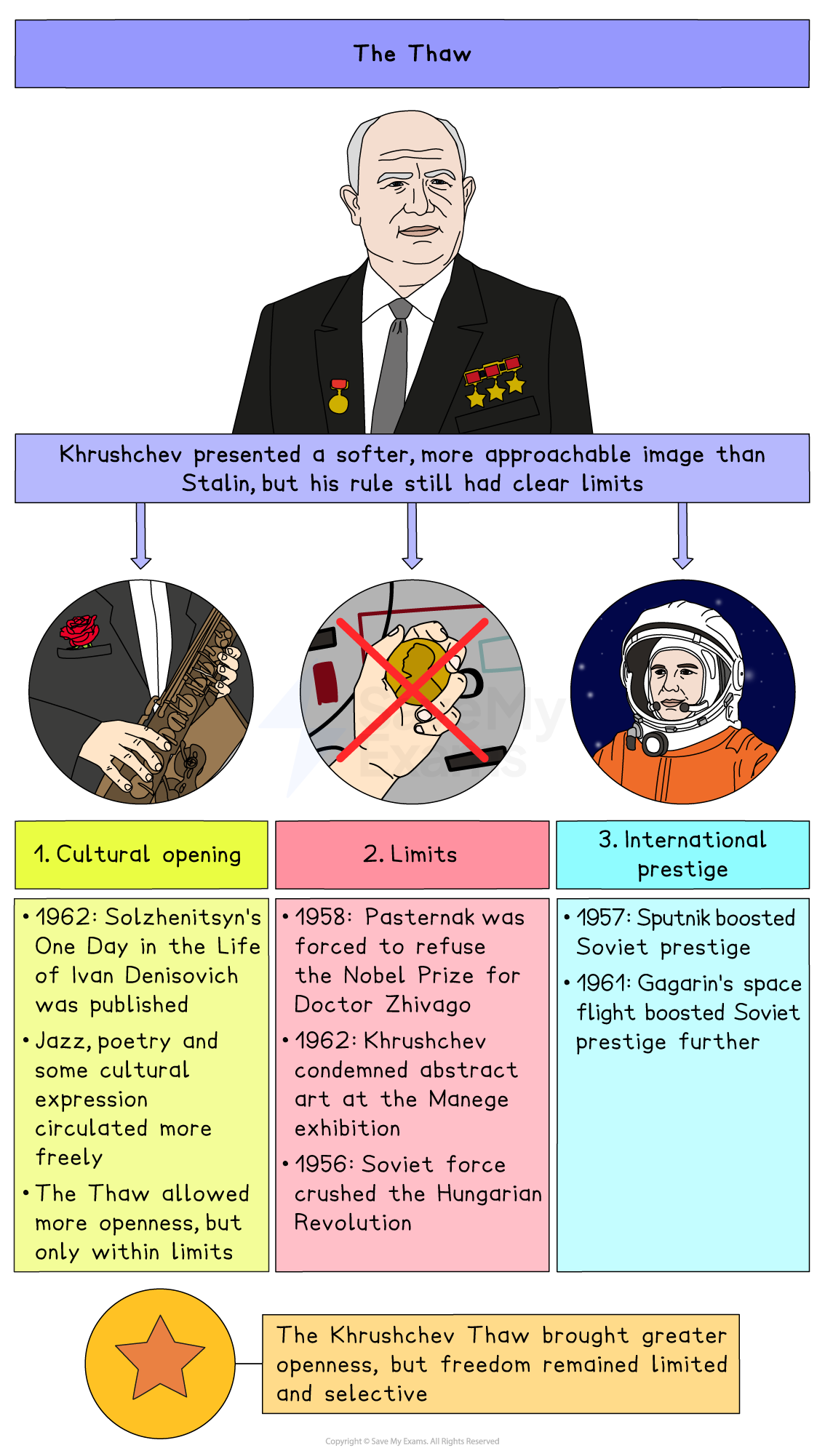
The cult of Khrushchev: a gentler personality cult?
Dismantling Stalin's cult
The Secret Speech of 1956 denounced Stalin's cult of personality and his crimes
It marked a deliberate break from the god-like veneration Stalin had enjoyed
Official language stressed Party rule
It moved away from the supremacy of one leader
The clearest symbolic break came in 1961
Stalin's body was removed from the Lenin Mausoleum
The 22nd Party Congress confirmed the public rejection of Stalin's personal cult
Khrushchev's own image
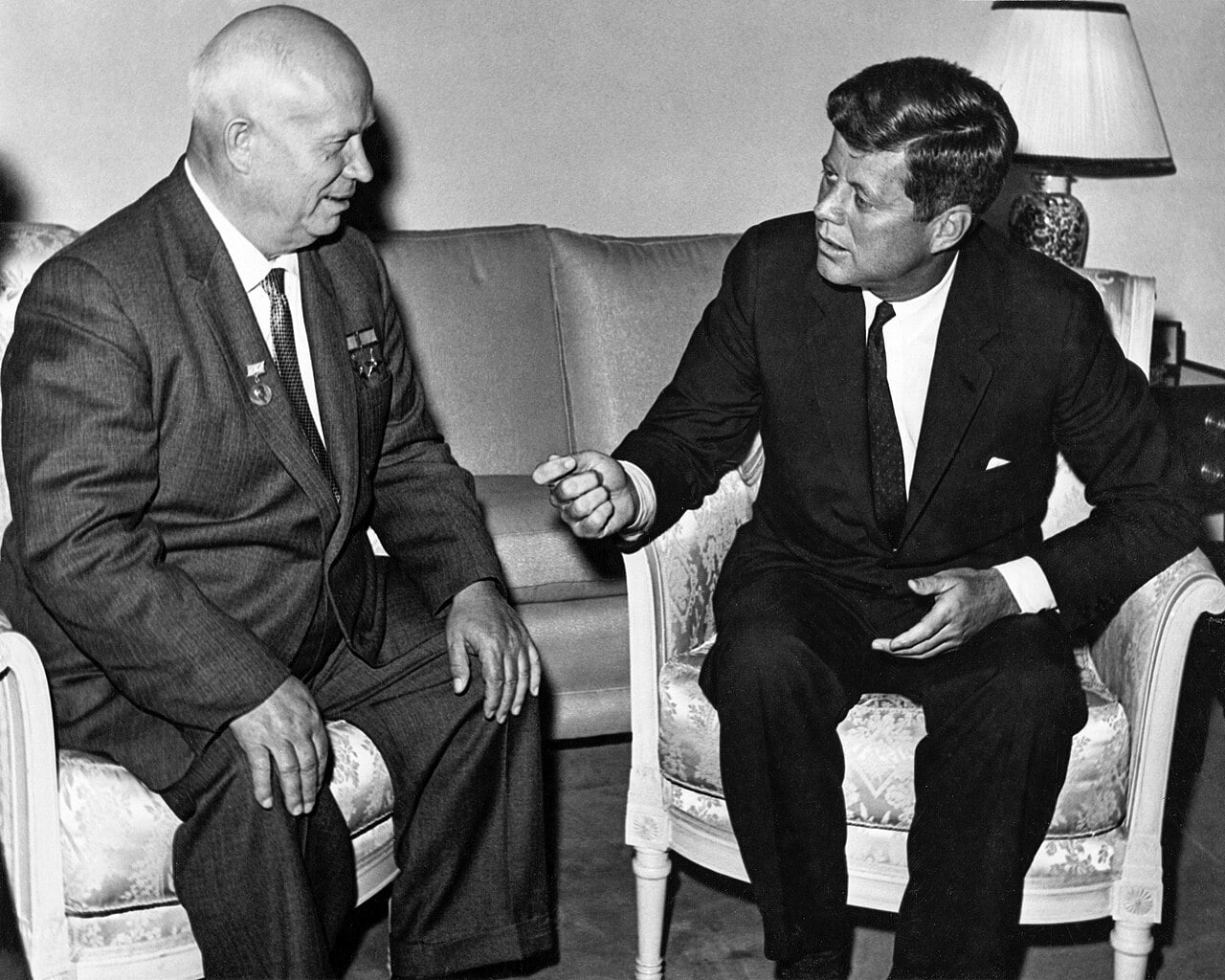
Khrushchev built a distinctive public personality
This was very different from Stalin's remote and sacred image
He appeared as a populist leader
He toured farms and factories
He spoke in a plain, "earthly" style
This contrasted with Stalin's isolation in his later years
Khrushchev presented himself as a respected Cold War statesman
He appeared on the world stage as a leader who could stand up to the USA while also promoting peace
Photographs of Khrushchev at summits with President Kennedy helped reinforce his image as an important global leader
Khrushchev still concentrated power in his own hands
He defeated the so-called Anti-Party Group in 1957
By 1958, he held the top Party and government posts at the same time
This echoed Stalin's earlier dominance
Khrushchev attacked his rivals for self-promotion
In 1957, he accused Marshal Zhukov of building his own personality cult
Khrushchev's rule was personalised and highly visible
However, it lacked the terror and deification that had sustained Stalin's cult
The result was strong personal leadership, instead
It was not the same as a worshipped, untouchable leader
Examiner Tips and Tricks
Be precise about the difference between personalised leadership and a cult of personality. Khrushchev clearly dominated Soviet politics, but he ended the terror and god-like worship that had defined Stalin’s rule.
Religious policies under Khrushchev
A renewed assault on the Churches
Khrushchev revived the campaign against organised religion
He targeted the Orthodox Church
He also targeted other Christian sects and Islam
Atheism was written into the school curriculum
It was now compulsory
From 1961, children were banned from church services
Parents were also banned from teaching religion to their children
Every higher education institution had to teach a mandatory course on the "foundations of scientific atheism"
The number of Orthodox churches fell sharply
There were around 22,000 in 1959
This fell to under 8,000 by 1965
Many churches were:
closed outright
turned into museums celebrating socialist values
used as community centres
Any remaining seminaries were shut down
Persecution of believers
Pilgrimages were banned
Strict rules controlled:
religious services
the ringing of church bells
Clergy who criticised atheism could be punished
They could be forced into retirement
They could also be arrested or sent to labour camps
Devout believers also faced risks of:
imprisonment
loss of jobs
removal of their children
At the Pochaev Lavra monastery, only 36 of the original 146 monks remained by 1962
This was due to constant harassment
Examiner Tips and Tricks
This campaign is strong evidence that the thaw had clear limits. A relaxation in culture and living standards did not mean religious freedom.
Use the fall in church numbers as a precise statistic. Avoid assuming that de-Stalinisation meant liberalisation across the board.
The impact of de-Stalinisation on Soviet culture: the thaw
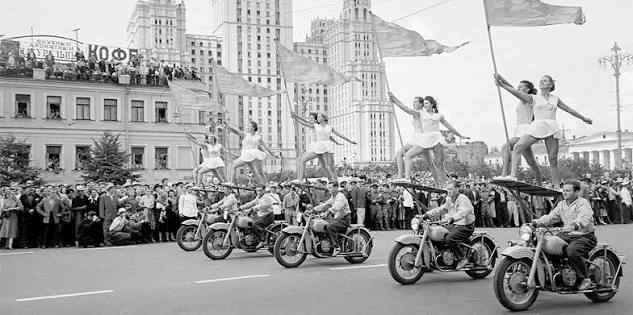
What was the "thaw"?
De-Stalinisation was accompanied by a cultural "thaw"
This brought greater personal freedom for Soviet citizens
The term comes from Ilya Ehrenburg's 1954 novel The Thaw
Restrictions were eased on:
foreign literature
foreign radio
what could be written or spoken about
Contact with the outside world widened
The World Festival of Youth in Moscow in 1957 drew 34,000 visitors from 131 countries
Intourist allowed foreigners to visit
It also allowed a limited number of Soviet citizens to travel abroad
Culture under the thaw
Some figures persecuted under Stalin were rehabilitated
This included the composer Shostakovich and writer Akhmatova
Solzhenitsyn was released from the labour camps
He was allowed to publish One Day in the Life of Ivan Denisovich in 1962
His account of the Gulag sold a million copies in six months
Western authors were sold in the USSR for the first time
This included Graham Greene and Ernest Hemingway
Banned works still circulated secretly through samizdat
The limits of the thaw
The relaxation was inconsistent and could easily be reversed
Khrushchev's own tastes were conservative
In 1962, he publicly condemned modern art at a Moscow exhibition
Boris Pasternak was forced to refuse the 1958 Nobel prize for Doctor Zhivago
He had been expelled from the Union of Writers
Work that challenged the basis of communism remained firmly banned
Culture was still judged by its "social responsibility"
It was not judged by artistic freedom
Examiner Tips and Tricks
The thaw can be understood as a swing rather than a steady opening. For every new freedom, there was a matching limit.
A good example to use here is Solzhenitsyn’s publication alongside Pasternak’s treatment. It illustrates the movement between relaxation and control.
Social reforms under Khrushchev: housing, welfare & living standards
Housing
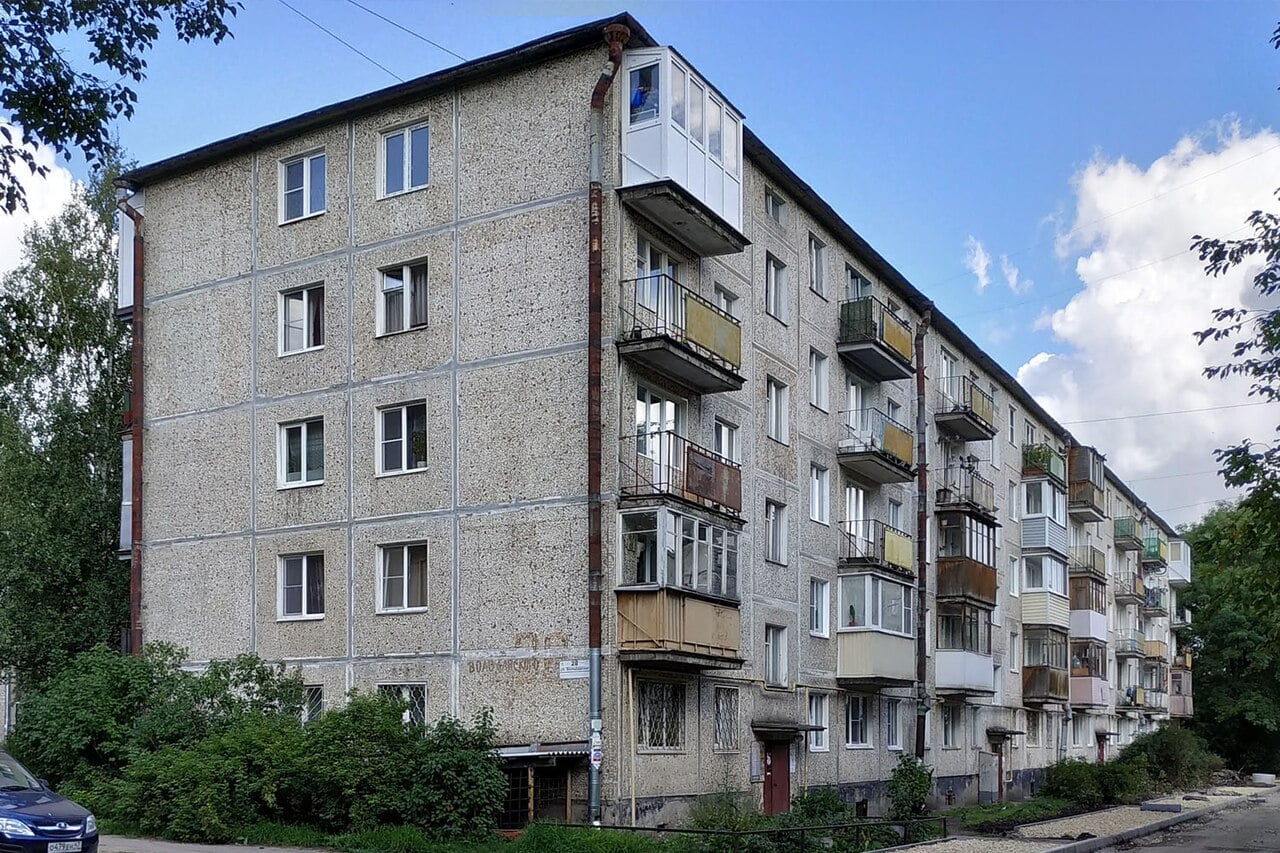
Khrushchev launched a mass housing programme to ease severe overcrowding
Prefabricated flats replaced the cramped communal apartments of the Stalin era
Urban housing roughly doubled between 1950 and 1965
Around 108 million citizens moved into new homes by 1964
The new khrushchyovki blocks gave families private facilities for the first time, including:
private kitchens
bathrooms
heating
For many people, this was their first experience of family privacy and independence
Welfare and living standards
A wage equalisation campaign raised the pay of the lowest earners
Wage differentials were lower than in any other highly industrialised country
The working week was cut with the introduction of the 40-hour week
In 1958, the bachelor's tax and the tax on childless couples were abolished
Pensions were improved
They were extended to farmers for the first time
Free lunches were introduced in schools and factories
Healthcare spending was doubled and thousands of clinics were built
Infant mortality fell from 81 to 27 per 1,000 births between 1950 and 1965
Life expectancy rose to around 68
Consumer goods
Consumer goods became more widely available
However, they often sold out quickly
Ownership of household goods rose sharply between 1955 and 1966
Khrushchev framed prosperity as proof that socialism could outperform capitalism
In a visit to East Germany in 1959, Khrushchev famously asked, "What sort of Communism is it that cannot produce sausage?"
The limits of reform
Privileges survived for the political elite
They still had access to scarce goods
They had better healthcare and holidays
These privileges undermined claims that the USSR had become an equal society
The quality of consumer goods remained poor
Living standards stayed below those of the industrialised West
Examiner Tips and Tricks
Living standards are a strong theme for change and continuity questions. Use the consumer goods table to show measurable progress, then qualify it with elite privilege and poor quality.
A statistic followed by a limitation is more convincing than a list of improvements.
Khrushchev’s policies toward the family
A shift away from Stalinist policy
Khrushchev moved away from Stalin's rigid, conservative family model
He recognised the impact of the Second World War
The deaths of around 10 million men had left many one-parent families
Women made up a growing share of the population
They rose from 52% in 1939 to 55% in 1959
Khrushchev's policies aimed to support women
They also aimed to ease the "double burden" of paid work and housework
Key measures
Abortion was made legal again in 1955
This reversed Stalin's 1936 ban
State-paid maternity leave was raised to 112 days in 1956
This was up from 77 days
Crèches, childcare facilities and laundries were expanded under the Sixth Five-Year Plan
The Seven-Year plan aimed to mass produce:
clothes
convenience food
refrigerators
Limited impact
In practice, everyday family life changed little
Crèches often opened late and closed early
This meant women could not work a full day
Some employers refused to grant full maternity leave
Household appliances remained scarce
Housework was still treated as women's work
The "double-burden" persisted
Examiner Tips and Tricks
Family policy is best used to show the gap between Soviet promises and Soviet reality. Khrushchev’s reforms were genuine in intent, but provision was patchy.
Link each measure to its limited outcome. This shows judgement, rather than just describing policy.
Did the USSR achieve a ‘stable society' by 1964?
By 1964, the USSR was calmer and more prosperous than under Stalin
However, historians disagree over how deep and secure this stability really was
The USSR moved towards a stable society
Fear receded as mass terror ended
Millions were released from the camps
Material security improved through:
housing
pensions
welfare
rising consumer ownership
For the first time, the state guaranteed full employment
It also provided a broad, if basic, network of social services
Everyday life became more predictable and less dangerous than under High Stalinism
By 1964, the USSR had become an easier place to live
Citizens were more hopeful about their families' futures
Key historian
"… the Soviet Union shifted from being a society defined by danger to one characterized by predictability … By moving the object of social policy to the immediate and rights-based improvement of individuals’ lives, Khrushchev fundamentally reformed one sphere of the Soviet system."
Adapted from M.B. Smith, The Withering Away of the Danger Society: The Pensions Reforms of 1956 and 1964 in the Soviet Union (2015)
Smith argues that Khrushchev’s welfare and pension reforms produced a genuine and lasting shift in how the state managed risk
This suggests the move towards stability was real rather than cosmetic
Stability was limited and superficial
New freedoms were inconsistent
They could be reversed at any time
Cultural relaxation was followed by renewed controls
Religious persecution intensified
Discontent persisted, especially among young people
A 1961 survey found most young people cynical about the ideals of the revolution
55% of the population was under 30
Prosperity rested on promises the system could not keep
The 1961 pledge of full communism by 1980 raised expectations far beyond what the economy could deliver
Elite privilege and poor-quality goods remained
This showed the USSR was far from equal or affluent
Key historian
"… The programme, endorsed by the 22nd Party Congress on 31 October 1961, declared that the Soviet Union had become a ‘state of the whole people’. It was no longer a dictatorship of the proletariat. This was the last authoritative document to take entirely seriously the building of a communist society."
Adapted from A. Brown, The Rise and Fall of Communism (2009)
Brown highlights the gap between the regime’s confident claims and reality
The 1961 promise of imminent communism was never met, which suggests stability was proclaimed more than securely achieved
Examiner Tips and Tricks
It is important to weigh the real gains in security and living standards against the limits of cultural freedom, religious repression and unmet promises.
A well-supported overall interpretation might suggest that society became more stable without becoming genuinely free or affluent.

Unlock more, it's free!
Join the 100,000+ Students that ❤️ Save My Exams
the (exam) results speak for themselves:

Was this revision note helpful?
