The Tsarist Response to Opposition: Censorship, the Okhrana and Repression (AQA A Level History: Component 1: Breadth study): Revision Note
Exam code: 7042

Summary
Tsarist censorship was a key tool of state control from 1826 onwards
Alexander III's 1882 Temporary Regulations on the Press gave the government power to close newspapers, ban editors and restrict what libraries could stock
The Okhrana was created in 1881 to replace the poorly run Third Section
It used surveillance, informers and agent provocateurs to infiltrate opposition groups
Repression often backfired during the 1870s
Vera Zasulich’s acquittal in 1878 and the Trial of the 193 created public sympathy for the Populists
The regime responded by moving political cases into closed courts
Administrative exile to Siberia required no formal trial
Hundreds of political opponents were removed from Russian cities each year, but exile did not stop revolutionaries organising or writing
Despite decades of repression, organised opposition grew
By 1905, the Socialist Revolutionaries (SRs), Bolsheviks and Mensheviks all had functioning underground parties
Historians debate whether repression could ever contain opposition
Waldron argues that opposition remained too narrow and elite-based to threaten the regime seriously
Figes argues that opposition was becoming too broad and mainstream for repression to control
Censorship in tsarist Russia: controlling the press and public debate
The Third Section and censorship before 1881
The Third Section, set up by Nicholas I in 1826, ran press censorship alongside its wider surveillance role
Censors read all publications before printing and could ban anything that challenged the Tsar, the autocracy or the Orthodox Church
By the 1870s, the Third Section, together with the attached Gendarmerie Corps, had around 16,000 agents, but was widely seen as poorly organised and corrupt
Under Alexander II, censorship was briefly relaxed in the 1860s
Newspapers gained more freedom to report on domestic affairs
Open court proceedings and zemstvo debates were covered more freely, giving educated Russians greater access to political discussion
After the Karakozov assassination attempt in 1866, controls tightened again
Dmitry Tolstoy was appointed Minister of Education to bring universities and the press back under stricter control
More liberal university courses were cut; student organisations were closely watched; censorship at universities was tightened
Alexander III's 1882 press regulations
Alexander III's 1882 Temporary Regulations on the Press were the toughest censorship laws of the period and remained in force until 1905
The government could close newspapers and ban editors and publishers from their jobs
All books and literary publications had to be officially approved before going on sale
Libraries and reading rooms were restricted in what they were allowed to stock
The regulations were 'temporary' but stayed in place for over twenty years
Censorship spread beyond print into theatre, education and cultural life
Theatre, art and music faced the same approval rules as the press
In non-Russian regions, events held in local languages were treated as a political threat and shut down as part of Russification
Students were banned from gathering in groups of more than five
The limits of censorship
Despite all this, press censorship never fully worked
Alexander Herzen's Kolokol (The Bell) was printed abroad and smuggled into Russia throughout the 1860s
Educated Russians were the main readers
Underground presses kept producing revolutionary pamphlets inside Russia itself
Exiled Social Democrats published Iskra (The Spark) from 1900 and got copies into Russia despite police efforts to stop it
Banning publications often made them more appealing to curious readers
Examiner Tips and Tricks
Know the difference between pre-publication censorship (approving work before it is printed) and post-publication seizure (confiscating material after printing).
The 1882 regulations shifted the focus toward closing newspapers after publication rather than just reviewing work in advance. Showing you understand this shift demonstrates real subject knowledge.
The Okhrana: Russia’s secret police
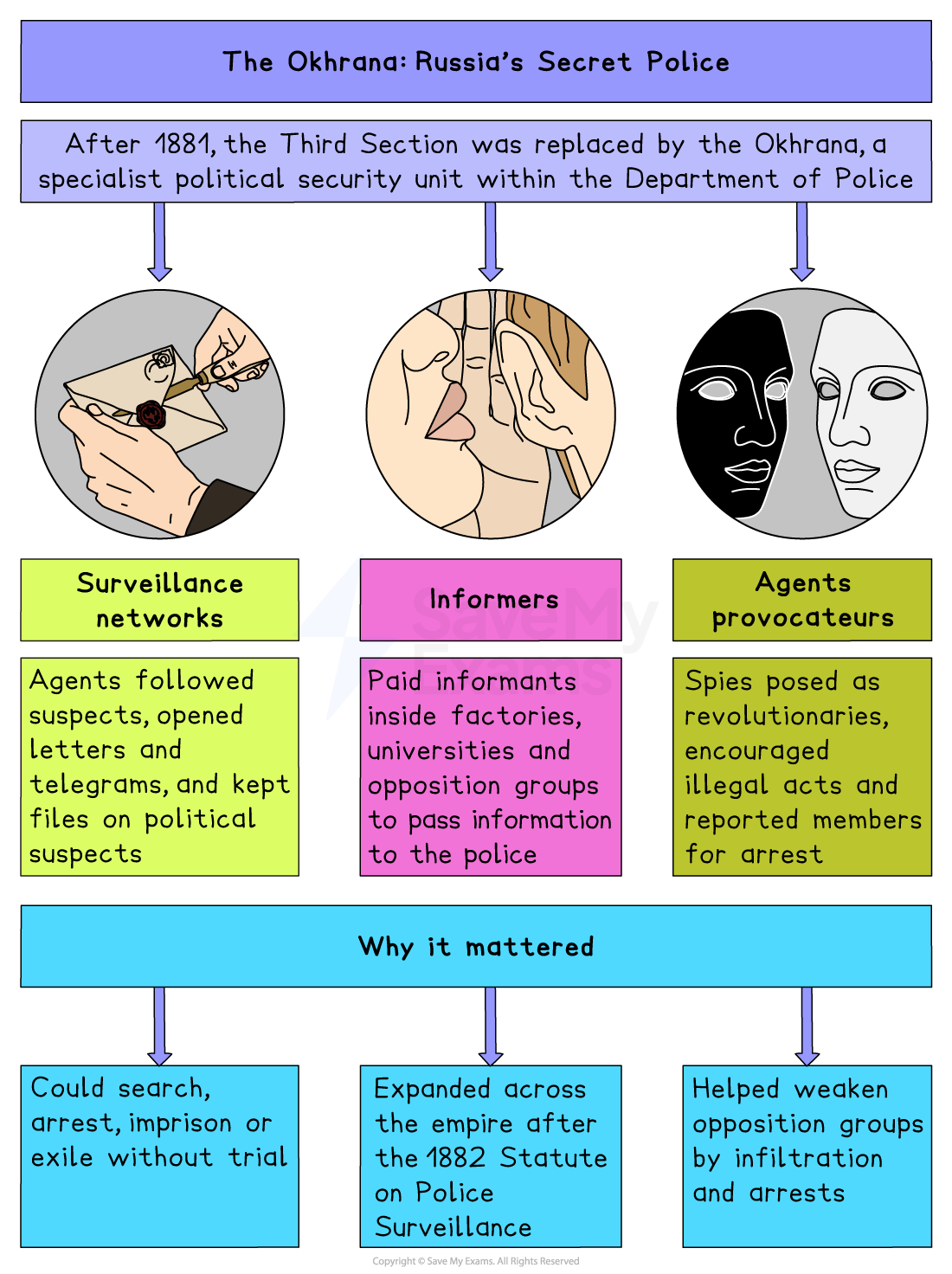
From the Third Section to the Okhrana
In August 1880, Loris-Melikov had already abolished the Third Section
He moved its powers to a new Department of Police within the Ministry of Internal Affairs
After Alexander II's assassination in 1881, Alexander III built on this restructuring
A specialist political security unit within the new Department became known as the Okhrana
The Okhrana was a significant improvement on the Third Section in terms of organisation and focus
It ran operations from offices in St Petersburg, Moscow and Warsaw
It opened and read private letters and telegrams, and kept watch on factories, universities, the army and the civil service
Under the 1881 Statute on Police Surveillance, it could search, arrest, imprison or exile people without a trial
Methods of the Okhrana
The Okhrana used three main methods to monitor and infiltrate opposition groups
Method | How it worked | Example |
|---|---|---|
Surveillance networks |
|
|
Informers |
|
|
Agents provocateurs |
|
|
The reach of the Okhrana
The 1881 Statute on Police Surveillance gave the Okhrana sweeping powers across the empire
Any part of the empire could be labelled an 'area of subversion'
In those areas, police could arrest, detain or exile anyone, even someone who had not broken any law
Simply knowing someone suspected of a crime was enough to get you arrested
The Okhrana expanded quickly through the 1880s under Von Plehve and then Durnovo
New branches were set up across the country; communists, socialists and trade unionists were the main targets
Civil servants and government workers were also monitored
The Okhrana had real successes against opposition groups by the 1890s and 1900s
Infiltrating the Socialist Revolutionaries led to around 4,500 arrests
Lenin was sent to Siberia and Trotsky was exiled twice, both directly because of Okhrana work
Getting Malinovsky as a spy onto the Bolshevik Central Committee caused serious damage to the Bolshevik organisation inside Russia
Examiner Tips and Tricks
Do not compare the Okhrana to the Cheka or NKVD. That comparison belongs to a later part of the course. The Okhrana was brutal, but it worked within a legal framework. Keep tsarist and Soviet repression clearly separate in your essays.
Show trials, exile & imprisonment in Tsarist Russia
Show trials
The regime held public show trials in the 1870s to:
Demonstrate that it was firmly in control
Deter others from joining opposition movements
Defence lawyers used the open courtroom to make speeches that spread revolutionary ideas to a wide audience
Sympathetic juries acquitted defendants whom the government had fully expected to convict
Instead of being branded as criminals, many defendants came out looking like heroes
Trial | Date | Outcome | Why it Mattered |
|---|---|---|---|
Trial of the 50 | 1877 |
|
|
Trial of the 193 | 1877 to 1878 |
|
|
Vera Zasulich trial | 1878 |
|
|
After 1878, the regime stopped holding open trials for political cases
Political crimes were moved to special, closed courts with no press access
From 1879, governors-general could send political offenders to military courts without a normal trial
This stopped the embarrassing acquittals, but it also meant no one outside the courts could see what was happening
Administrative exile and imprisonment
Administrative exile to Siberia was the most widely used punishment for political opponents
No formal trial was needed
A governor-general or government committee could order exile on their own authority
Hundreds of political suspects were sent into exile every year under Alexander II and Alexander III
Exile got people out of the cities but did not stop them organising
Lenin spent three years in Siberian exile (1897 to 1900)
He used the time to write The Development of Capitalism in Russia and stay in contact with other revolutionaries
Exiles in remote towns could still send letters, meet each other and make plans
The Okhrana even tracked Russians who had fled abroad, monitoring communities in Geneva, Zurich and London
The Peter and Paul Fortress in St Petersburg held the most high-profile political detainees
Conditions were harsh: solitary confinement, very limited reading material and almost no contact with the outside world
From 1881, the regime could imprison people without any trial at all under its emergency powers
Examiner Tips and Tricks
On exile: do not assume it was automatically effective just because people were physically removed.
The more important question is what exiles did with their time. Lenin read, wrote and planned during his years in Siberia. Exile could strengthen a revolutionary's ideas and reputation rather than destroying them.
How effectively did the tsars deal with opposition?
The tsars used censorship, the secret police, show trials, exile and local controls such as Land Captains to contain opposition
But historians disagree about whether these tools were enough
This question asks you to weigh both sides together
Draw on the nature of opposition and the methods of repression covered in this note
Repression was effective enough to contain the threat
The regime survived from 1855 to 1905 without a successful revolution
The autocratic system stayed intact throughout, despite assassination attempts and growing opposition
After each major crisis, the regime tightened its controls and opposition could not stop it from doing so
The Okhrana inflicted serious and lasting damage on revolutionary organisations
Infiltrating the Socialist Revolutionaries (SRs) led to around 4,500 arrests
Lenin was sent to Siberia and Trotsky was exiled twice
Malinovsky, on the Bolshevik Central Committee, seriously disrupted Bolshevik work inside Russia
Censorship kept radical ideas away from most of the Russian population
Around 80 per cent of Russians were peasants with limited literacy
Most never came into contact with revolutionary ideas at all
Underground printing operations were regularly raided and broken up
Local controls helped prevent rural discontent from becoming organised political opposition
The Land Captains Act of 1889 placed peasant communities under appointed noble officials
This strengthened state control in the countryside, where most Russians lived
The structural weaknesses of the opposition played into the regime's hands
Waldron shows opposition came from the same educated class as the regime itself and had no independent mass base among ordinary Russians
The failure of 'Going to the People' in 1874 proved that the peasantry would not be mobilised
Revolutionary groups remained small and vulnerable to infiltration
Key historian
"Russian political life before 1917 was overwhelmingly the preserve of social elites. The formal structures of government and bureaucracy were dominated by educated noblemen. The middle classes, which were making their mark on the politics of Western Europe, were much slower to emerge in Russia. In addition, the groups and individuals who manifested opposition to the autocracy came in large part from the same social background as those who made up the regime which they sought to reform or destroy."
P. Waldron, The End of Imperial Russia, 1855 to 1917 (1997)
Waldron argues that opposition was structurally limited by its social origins
It emerged from the same educated class it opposed and lacked the independent mass base that had driven liberal reform in Western Europe
This structural weakness made it easier for the regime to contain: a movement without mass support is one that the police can infiltrate and disrupt
Repression was self-defeating and never destroyed opposition
Show trials in the 1870s badly damaged the regime's image rather than deterring opposition
Vera Zasulich shot the Chief of Police of St Petersburg and was acquitted
She became a popular figure overnight
The Trial of the 193 spread Populist ideas far more widely than the regime intended
The assassination of Alexander II in 1881 was the biggest single failure of the regime's security system
The Tsar was killed despite years of intensive surveillance and clear warnings about threats to his life
It showed that a small, determined cell could get through even a large and active secret police operation
Repression could also radicalise future revolutionaries
In 1887, Lenin’s older brother, Alexander Ulyanov, was executed for his role in a plot to assassinate Alexander III
His execution strengthened Lenin’s hatred of tsarism and helped shape his commitment to revolutionary politics
This showed that harsh punishment could create martyrs and deepen opposition, rather than destroying it
Censorship could not stop radical ideas from reaching educated Russians
Herzen's Kolokol was smuggled in from abroad and widely read throughout the 1860s
Iskra was produced in exile from 1900 and distributed inside Russia, even as the Okhrana tried to block it
Agents provocateurs created a problem that the Okhrana could never fully solve
To gather evidence, agents encouraged illegal activity
This sometimes meant they helped plan the very attacks they were supposed to prevent
Azef ran the SR Combat Organisation while on the Okhrana payroll and personally organised several assassinations
By 1905, opposition was bigger and better organised than it had been in 1855
The SRs, Bolsheviks and Mensheviks all ran functioning underground parties with clear aims and structures
Figes shows that after the 1891 famine, opposition spread beyond underground radicals to include zemstvo professionals and mainstream educated Russians
Repression kept the opposition from taking power
But it never dealt with the poverty, injustice and lack of political rights that drove people into opposition in the first place
Key historian
"Russian society was polarised by the Great Famine, and from 1891 it became more organised in opposition to the government. The zemstva expanded their activities to revive the rural economy. Doctors, teachers and engineers began to demand more influence over public policy. In the press and periodicals, in universities and learned societies, there were heated debates on the causes of the crisis in which Marx's ideas of capitalist development were generally accepted as the most convincing explanation of the peasantry's impoverishment."
O. Figes, Revolutionary Russia 1891 to 1991 (2014)
Figes argues the 1891 famine was a turning point that widened opposition beyond underground radicals to include mainstream educated professionals
This directly challenges the case for repression's effectiveness: if opposition was spreading into the zemstvo class that the regime depended on, then decades of censorship and policing had clearly failed to contain the problem
Examiner Tips and Tricks
Watch the dates carefully. Before 1905, you could make a reasonable case that repression was working, because the regime survived. After 1905, the picture changed: the October Manifesto was a forced political concession, and opposition became more organised than ever. An answer that stops at 1905 will miss a large part of the argument.

Unlock more, it's free!
Join the 100,000+ Students that ❤️ Save My Exams
the (exam) results speak for themselves:

Was this revision note helpful?
