Art in the USSR: From Avant-Garde to Socialist Realism (AQA A Level History: Component 1: Breadth study): Revision Note
Exam code: 7042
Summary
The Bolsheviks treated art as political work
It was used to raise literacy, attack bourgeois culture and build socialism
Under Lenin, different approaches to art coexisted
Proletkult promoted worker-led culture
The avant-garde experimented with movements such as Constructivism and Suprematism
From 1928, the First Five-Year Plan was matched by a cultural revolution
Bourgeois artists were attacked
Artistic independence was reduced
A 1932 decree replaced independent groups with state-run unions
The 1934 Writers' Congress made Socialist Realism the compulsory style
Socialist Realism turned art into propaganda
It demanded optimistic, heroic images of workers
It glorified Lenin, Stalin and the achievements of socialism
Historians debate how important controlling the arts was to the Soviet government
Fitzpatrick argues control worked through co-option and negotiation, making it an effective tool of power
Brown argues tight control forced conformity and stifled creativity
Bolshevik attitudes to the arts: Proletkult and avant-garde
Art as political work
The Bolsheviks treated culture as political work
Art should serve the revolution
It should raise literacy and spread socialist values
It was also a weapon against bourgeois culture
Art was useful in a largely illiterate population
Posters, theatre and film could reach people who could not easily read political texts
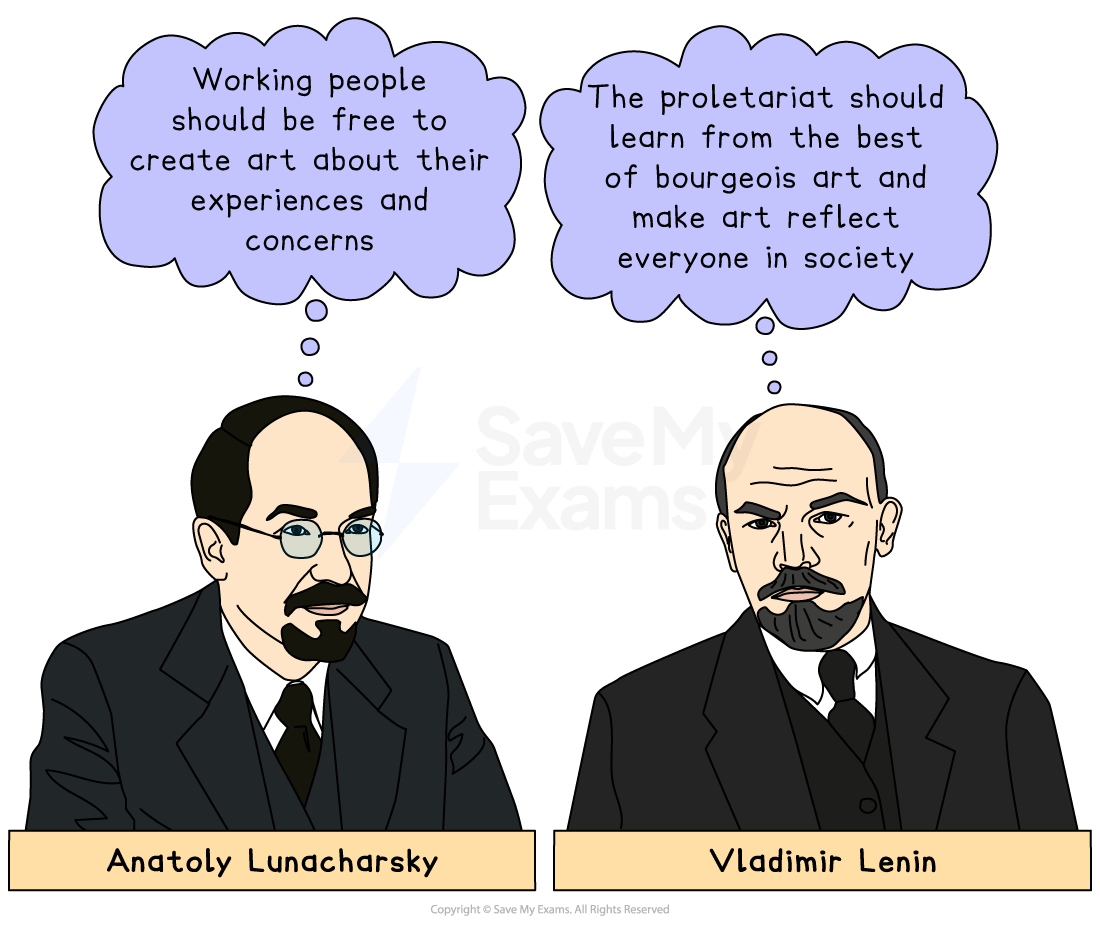
Bolsheviks disagreed over what proletarian art should be
Anatoly Lunacharsky, the Commissar of Enlightenment, wanted workers free to create their own art
Lenin wanted art to use the best of bourgeois culture and serve society as a whole
Proletkult
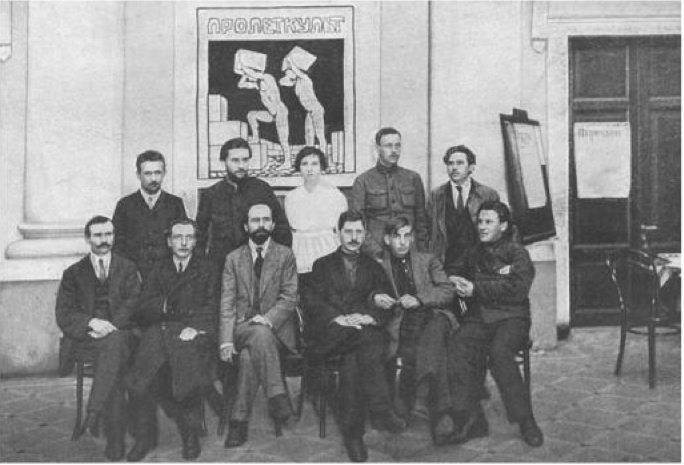
Proletkult, meaning "proletarian culture", aimed to create art by and for workers
It wanted a distinct working-class culture
This culture would be free from bourgeois traditions
It ran independently of the Communist Party
It was backed by figures such as Bukharin
By 1920, the Proletkult had around 84,000 members
From 1918 to 1920, Proletkult gave workers access to creative spaces
Workers could paint, sculpt and stage plays
It organised clubs and exhibitions across Russia during the Civil War
Lenin distrusted Proletkult and moved to end its independence
He disliked its links to Futurism
He feared a cultural body outside Party control
It was accused of being dominated by "enemies of the state", such as anarchists
In 1920, it was forced to merge with the Commissariat of Education
The avant-garde
Avant-garde artists wanted to revolutionise art
They experimented with abstract shapes, bold colours and modern forms
The government tolerated them while their work supported and spread revolutionary ideas
Key avant-garde movements
Movement | Key Figures and Features |
|---|---|
Constructivism |
|
Suprematism |
|
Avant-garde ideas also appeared in film
Sergei Eisenstein used montage to create emotion in films like Battleship Potemkin (1925)
Dziga Vertov’s Man with a Movie Camera (1929) used documentary style to show modern, urban life
Decline of the avant-garde
By the end of the 1920s, critics argued that avant-garde art was too abstract for workers to understand
Instead, the Party demanded realistic art that showed happy workers and socialism's progress
This shift led to the rise of Socialist Realism under Stalin in the 1930s
Agitprop
What was it?
Agitprop was short for "agitation and propaganda"
It used simple methods to spread political messages
It helped educate and inspire the masses
It was especially useful for people who were illiterate
Features of agitprop
Simple, bold images and text
Clear and emotional slogans
Bright colours
Often black, white and red
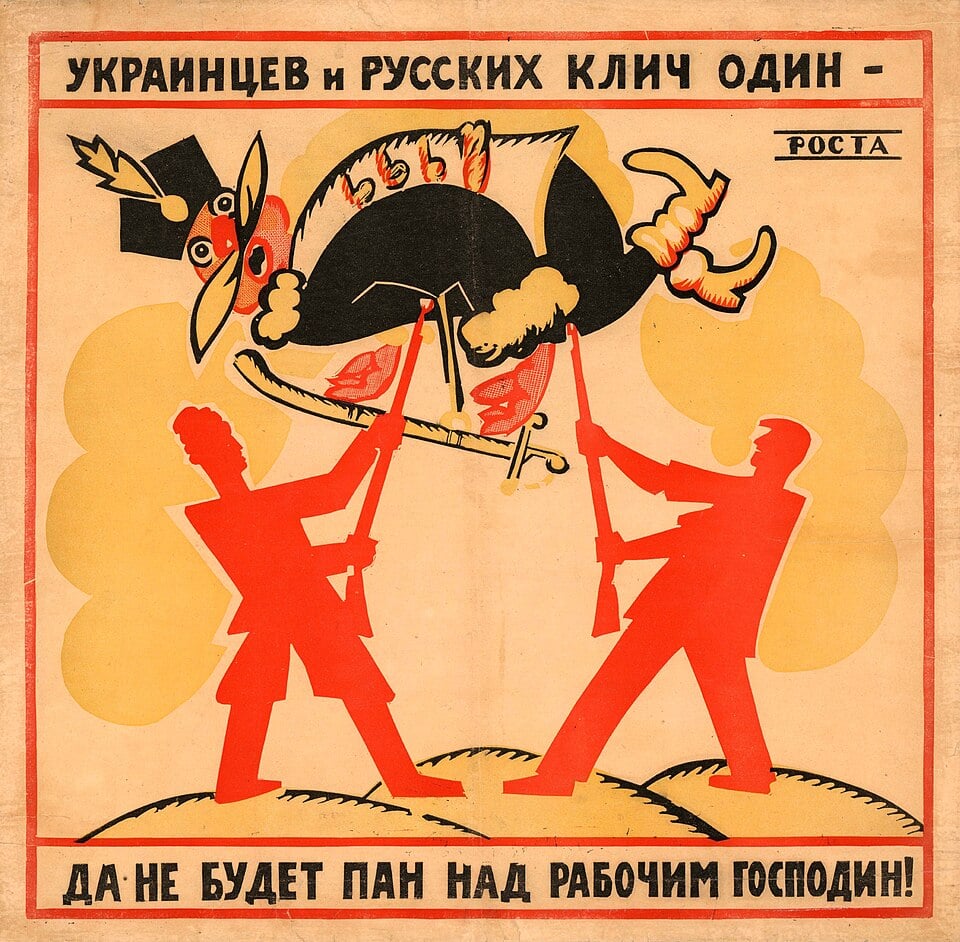
ROSTA windows were a key form of agitprop
These were painted posters displayed in shops or factory windows
They used cartoons and short captions to show revolutionary news
Agit-trains and agit-boats carried propaganda across Russia
These travelled across Russia
They showed short plays, posters and films
They brought revolutionary ideas to rural areas
Examiner Tips and Tricks
Cultural policy is easy to overlook, but it appears regularly in questions on social change. Be ready to explain the Bolshevik view that art was political work, not decoration: a way to raise literacy, attack bourgeois culture and build socialism.
The Cultural Revolution under Stalin
A cultural offensive
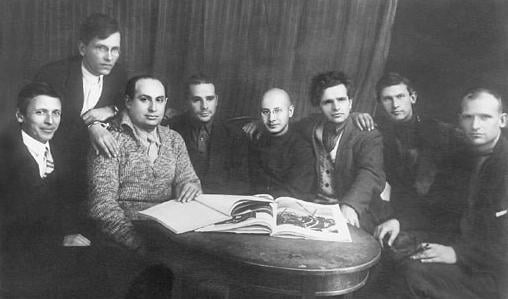
From 1928, the First Five-Year Plan was matched by a cultural "offensive"
It targeted "bourgeois specialists"
It attacked other cultural elites
Militant groups, such as RAPP, attacked "elitist" artists
They demanded proletarian content
They wanted art to serve socialist construction
Komsomol activists were sent to police theatres and studios
Many established professions were denounced
Some were silenced or exiled
The decree of 1932
In April 1932, a decree abolished independent artistic groups
It created a single state-run union for writers, artists, composers and filmmakers
Every art form was now organised under direct Party control
Examiner Tips and Tricks
Cultural policy is not just about style. The cultural revolution was part of Stalin’s wider drive for control. Link it to the First Five-Year Plan, attacks on bourgeois specialists and the creation of state-run unions.
Socialist realism: art as propaganda
Socialist Realism began to emerge in the early to mid 1930s
Stalin pushed this change in artistic approach
It became the compulsory style
The First Congress of the Union of Soviet Writers formally defined Socialist Realism in 1934
It required optimistic, accessible and heroic images of Soviet life
It had to show life not only as it was, but as it should be under socialism
Themes of Socialist Realism
Theme | What it showed |
|---|---|
The noble worker |
|
Industrial gigantism |
|
Victories over enemies |
|
The cult of leaders |
|
Examiner Tips and Tricks
Use the terms precisely. The Cultural Revolution was a deliberate offensive against bourgeois specialists. Socialist Realism was formally defined by Zhdanov in 1934 at the Writers' Congress. Showing exactly what changed, and when, lifts an answer above narrative.
How important was the control of art to the Soviet government?
Historians disagree over whether control of the arts strengthened the Soviet regime or mainly restricted creativity
Controlling the arts was an effective instrument of Soviet power
Control gave the regime a single message across the arts
Posters, paintings and novels carried repeated propaganda
This helped spread Soviet values to a mass audience
Rising literacy widened the reach of this controlled culture
Idealised images legitimised the leadership
They also strengthened the cult of Lenin and Stalin
Control worked through co-option as well as force
The regime used respected figures such as Maxim Gorky
This helped deepen cultural authority
Key historian
“Yet in all periods, the relationship between the party and culture was far more complex than a we-they image suggests... If final authority was vested in the party, the party nevertheless delegated, bestowed, or countenanced other types of cultural authority that resided in individuals or cultural institutions... Yet at the same time, leadership’s attitude towards many established cultural values was more often deferential than destructive.”
S.Fitzpatrick, The Cultural Front: Power and Culture in Revolutionary Russia (1992)
Fitzpatrick stresses that Party control was negotiated
It often worked through established cultural figures
On this view, art became an embedded and effective instrument of rule
It was not simply a blunt imposition from above
Controlling the arts stifled creativity at a heavy cost
Tight control forced conformity
Experimental and abstract work was condemned
Independent voices were silenced
Artists had less freedom over what they could produce
Rigid optimism clashed with lived experience
Audiences learned to read between the lines
This weakened the credibility of the official message
For many people, other pressures mattered more than approved art
Terror, work and shortages shaped daily life more than artistic doctrine
Key historian
“The approved form of art was Socialist Realism. This meant representational art which was realistic only up to a point. It had to be imbued with optimism and to present an idealised view of workers and peasants... To listen to the guidance of party and state officials and the guardians of orthodoxy in the state-sponsored artistic unions was the path to a comfortable existence for the artist.”
A. Brown, The Rise & Fall of Communism (2009)
Brown argues that Socialist Realism forced artists into conformity
State-sponsored unions enforced the official line
Artists who submitted could build safer careers
On this view, control stifled creativity and carried real costs
Examiner Tips and Tricks
Avoid treating control as total. The best answers recognise that artists negotiated, evaded and conformed unevenly. The regime also worked through established figures rather than simply crushing them. Use that nuance to support a clear, balanced argument.

Unlock more, it's free!
Join the 100,000+ Students that ❤️ Save My Exams
the (exam) results speak for themselves:

Was this revision note helpful?
