The Condition of the Soviet Union by 1964 (AQA A Level History: Component 1: Breadth study): Revision Note
Exam code: 7042

Summary
By 1964, the USSR was a nuclear superpower with a vast industrial base
However, its command economy could no longer sustain fast growth
Stalin's death in 1953 left a political vacuum
His successors ruled through the Party rather than through personal terror
Khrushchev's reforms softened the system
However, the one-party state and the command economy were never questioned
Living standards rose faster than ever in the 1950s
Yet, consumer goods remained scarce and poor in quality
De-Stalinisation ended mass terror and freed millions
However, political and cultural freedom remained limited
Historians debate whether the USSR by 1964 was a genuinely new and more responsive settlement or a system whose real gains fell far short of its people's needs
Christian sees an unspoken "social contract" trading political control for rising living standards
Service sees undeniable achievements that improved on Stalin but fell greatly short of the country's needs
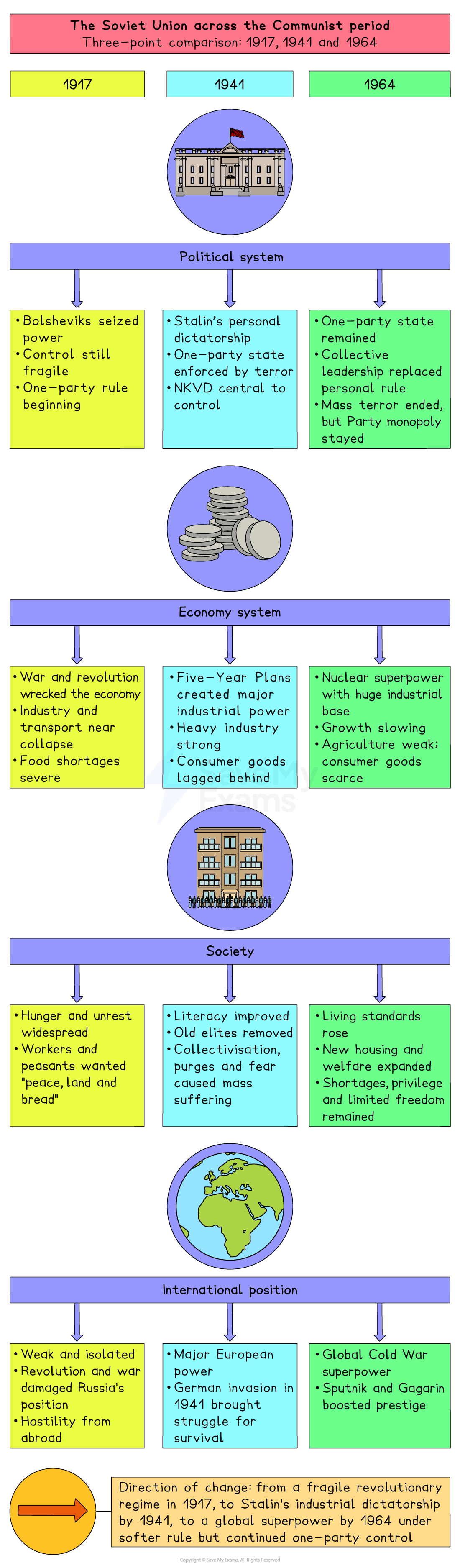
The political condition of the USSR by 1964
Stalin's death in 1953 opened an era of reform, yet the foundations of the system stayed in place
His successors softened Stalinism through collective leadership and ended mass terror
However, they never removed the one-party state or the Party's monopoly on power
Theme | Strengths of the System | Costs and Weaknesses |
|---|---|---|
The Party's structure and power |
|
|
Leadership and those at the top |
|
|
Political ideology |
|
|
Political opposition |
|
|
Examiner Tips and Tricks
When looking at the political condition, it helps to think in terms of change alongside continuity. Some things clearly shifted, like the end of personal terror and the move to collective leadership, while others stayed the same, especially the Party’s continued monopoly of power.
It’s better to avoid oversimplified claims that the system was completely “transformed” or totally “unchanged”. A more balanced view, using careful judgement, gives a clearer picture of how the system actually developed.
The economic condition of the USSR by 1964
The Stalinist era left a huge industrial base, and by 1964 the USSR was a genuine nuclear superpower
Around 70% of industrial capacity destroyed in the war had been rebuilt by 1953
The unsolved problem was how to sustain growth and repair a weak agricultural sector
Theme | Achievements | Costs and Limits |
|---|---|---|
Command economy and planning |
|
|
Heavy industry |
|
|
'Newer' industry and technology |
|
|
Agriculture |
|
|
Examiner Tips and Tricks
The economy is best judged as a balance sheet. The USSR was a superpower in heavy industry and armaments, yet chronically weak in agriculture and consumer goods, so a one-word verdict rarely convinces.
Define what you mean by “success” before you judge. Output targets, living standards and sustainability point to different conclusions. Saying which one you are testing keeps the argument tight.
The social condition of the USSR by 1964
Living standards rose faster in the 1950s than at any earlier point under Communist rule
For the first time, many families gained better housing, welfare and consumer goods
Beneath the new optimism, deep problems of scarcity and inequality remained
Theme | Gains | Costs and Limits |
|---|---|---|
Material position and housing |
|
|
Quality of life |
|
|
Cultural freedom |
|
|
Examiner Tips and Tricks
Living standards are a rich theme for change-and-continuity questions. Define “conditions of living” as both material possessions and quality of life, including personal and cultural freedom.
The most convincing answers argue that some aspects improved while others did not, rather than treating social change as a single upward trend.
What was the state of the USSR by 1964? Assessing the communist legacy
The state of the USSR by 1964 was a complex mix of real gains and stubborn weaknesses
There had been genuine change since 1941, set against major problems that reform had not solved
Historians divide over how to weigh that balance, a disagreement really about the whole Communist experiment begun in 1917
A new and more responsive settlement
The post-Stalin government was less coercive and more sensitive to popular demands
An unspoken "social contract" traded the Party's political monopoly for:
rising living standards
full employment
welfare
Consumers began to benefit from the earlier industrialisation drive
From this perspective, the USSR had reached a genuinely new and more stable stage
It was not simply a softer version of Stalinism
Key historian
“The less coercive government that emerged in the 1950s negotiated a new ‘social contract’ with Soviet society ... The unspoken contract ... allowed the government to keep its monopoly on political power ... In return, the government began to raise material living standards, while guaranteeing full employment and an extensive, if low grade network of social services.”
Adapted from D. Christian, Imperial and Soviet Russia (1986)
Christian frames 1964 as a positive settlement
Political freedom was still denied
However, the state now delivered security and rising living standards in return
Real gains still fell short
The achievements were undeniable: mass terror ended, living standards rose
Yet, further improvements stalled
The political, economic and cultural order remained authoritarian
The reform stayed half-hearted and erratic
The promised communist future "seemed as remote as ever"
From this perspective, 1964 represented an advance on Stalin
Yet the system still failed to satisfy the needs of its people or achieve its own aims
Key historian
“Khrushchev’s achievements were undeniable, especially in the ending of the Terror and the raising of the general standard of living ... His political, economic and cultural accomplishments were a great improvement over Stalin. But they fell greatly short of the country’s needs.”
Adapted from R. Service, Russia (1997)
Service accepts the gains, yet stressed their limits
An improvement on Stalin was not the same as meeting the needs of the country
It was also not the same as fulfilling the promises of 1917
Examiner Tips and Tricks
This synthesis helps when thinking about different interpretations of change from 1941 to 1964. It’s useful to understand the overall argument behind each view first, then compare them, rather than just listing what changed.

Unlock more, it's free!
Join the 100,000+ Students that ❤️ Save My Exams
the (exam) results speak for themselves:

Was this revision note helpful?
